Exploring Nature with Orni & Friends
Did you go to ʻExploring Nature with ORNI & Friendsʼ ?
This event was held over two full days from 4th to 5th December 2010 at the Penang Butterfly Farmʼs open car park in Teluk Bahang and it was open to public with free admission.
Our beloved Penang Chief Minister YAB Lim Guan Eng, Penang State EXCO for Tourism Development & Culture YB Danny Law and Managing Director of Penang Global Tourism Sdn Bhd, Miss Ooi was here to officiate our 5 mascots as well as launching of the ecological event entitled as “Bring Back The Endangered Yellow Birdwings” as a community project in Penang.
This event was most meaningful to the locals whom we have provided with countless nature education programmes and also in appreciation of their endless support during the past 24 years. The public including the tourists, families, children, teachers, students from all schools, kindergartens had came to participate in these series of activities.
Here are some photos of what happened those 2 days!

Children enjoy finding and counting the phasmids at our Bug-A-Boo challenge!
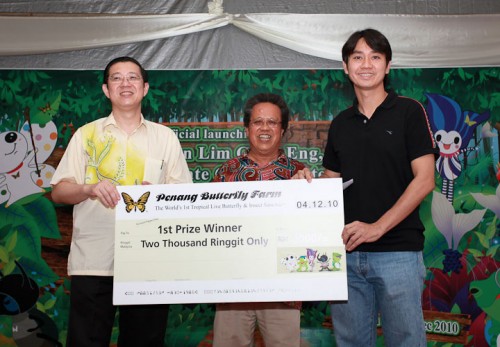
Prize Giving to Winners of the 2nd Butterfly & Insect Photographic Competition
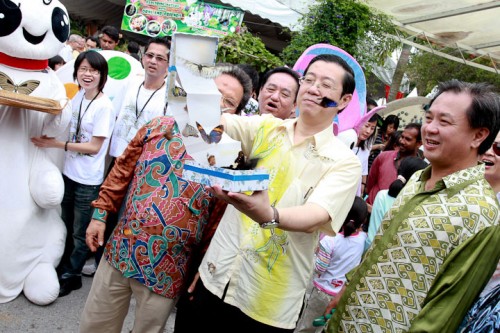
YAB Lim Guan Eng releasing butterflies at the Penang Butterfly Farm.
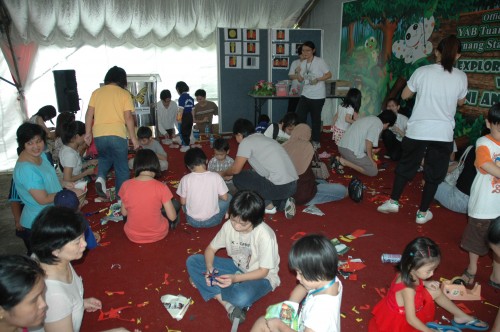
Get Crafty! Art & Craft Session at Penang Butterfly Farm
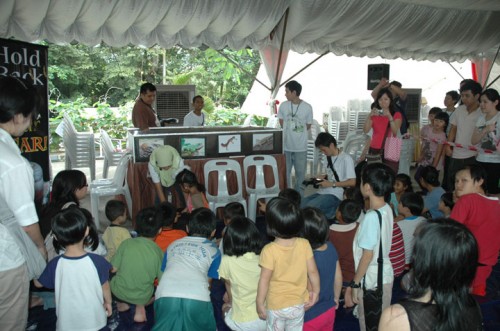
The "Hold Back Your Fear!" session lets children and the public get close to some reptiles and lizards.
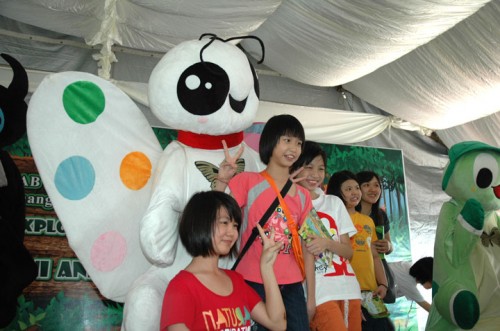
Everyone gets to be photogenic during the special mascot appearance session.
Orni & Friends Are Nature Ambassadors
Through this meaningful event, our mascots play their role as “nature ambassadors” to raise public awareness of our environment and advocate nature-loving in improving our living conditions. These mascots will endeavour to inspire the public, and especially the children to learn and pick-up nature-loving values. In conjunction with Penang Stateʼs objective in creating a greener cleaner Penang city, Penang Butterfly Farm’s mascots will unendingly help the state and the nation to play the role of saving our earth from further deterioration. In the near future, these mascots will make their special appearances during our nature education workshops, public events as well as during our conservation activities.
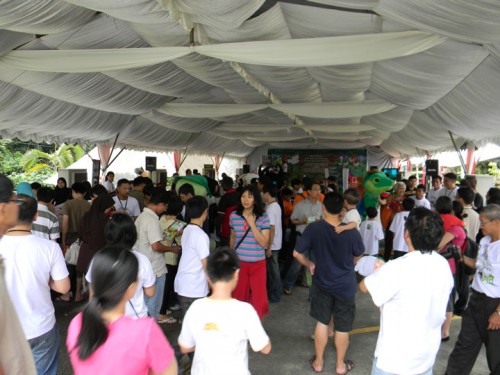
People just kept pouring in during the whole day at our event! Can you spot Dagon the Water Dragon?
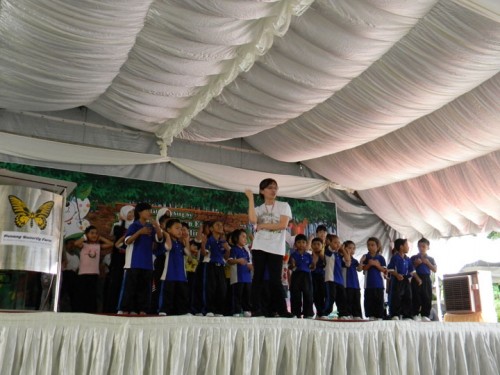
On one morning, some kids were yawning away so we showed them how to dance like a professional. Watch the Cat dance!
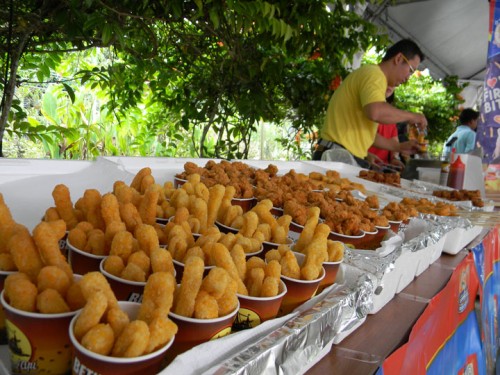
Plenty of food for those 2 days!
Bring Back The Endangered Yellow Birdwings
In the past few years, Penang Butterfly Farm has been sending out nature-conservation messages through its nature educational programmes, events, conferences, workshops and exhibitions. This year, Penang Butterfly Farm, being committed to promote awareness of the environment and butterflies in Penang, is embarking on a butterfly conservation and nature awareness project called “Bring Back The Endangered Yellow Birdwings” by planting back its host plant in the viable localities within Penang state, through the collaboration with some local schools which have accepted Penang Butterfly Farmʼs offer to sponsor them mini butterfly gardens. These pilot schools include Penang Free School, SRJK (C) Hun Bin Primary School, and Dalat International School.
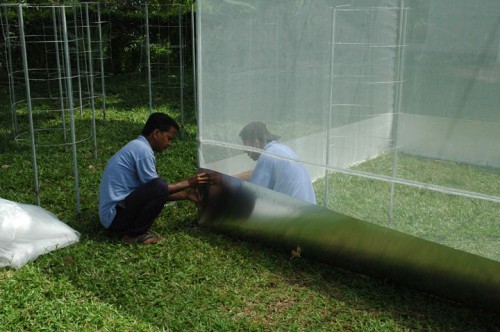
Construction of the butterfly aviary at SJK(C) Hun Bin, a primary school in Penang.
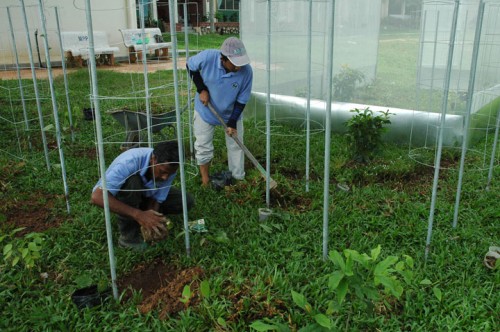
Landscaping of the mini butterfly aviary and garden at SJK(C) Hun Bin.

SJK(C) Hun Bin now has a butterfly aviary in order to conserve our Yellow Birdwings!
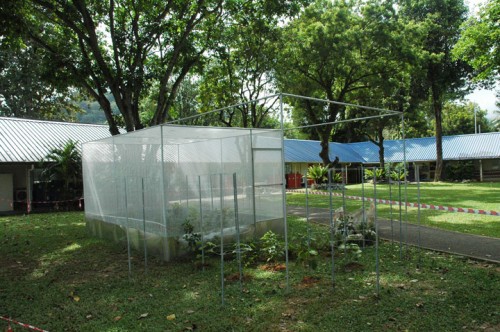
Bring Back The Endangered Yellow Birdwings! - We also sponsored Dalat International School the same butterfly aviary.
Posted in Events & Workshops |
2nd Butterfly & Insect Photographic Competition Winners!
Congratulations to all our winners!!!
1st Prize Winner – Eddie Chuah Seng Kim
2nd Prize Winner – Chuah Huat Beng
3rd Prize Winner – Teoh Siang Hooi
Consolation Prizes
Tan Cheong Pheng
Tan Meng Teong
Eric Ooi Kar Chuan
Wong Chee Seng
Chua Choon Sen
Lim Kien Hock
Chin Poh Check
Ong Pang Wei
Lee Xiao Mei
Ooi Oon Thong
Tags: photography
Posted in Photos |
Exploring Nature with Orni & Friends – this weekend!
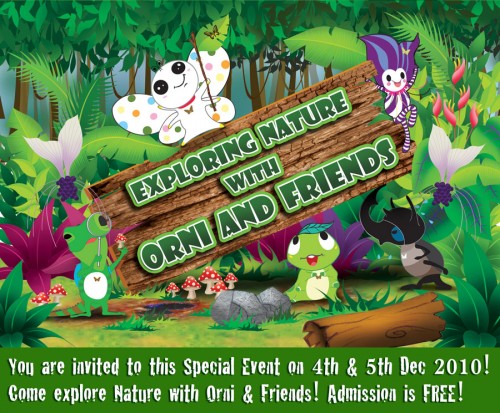
On the 4th and 5th December 2010, you are invited to visit Penang Butterfly Farm’s nature appreciation event “Explore Nature with Orni & Friends” !! Don’t miss it !!
See the itinerary for those 2 days >>
Tags: penang event
Posted in Latest News |
The 2nd Butterfly & Insect Photographic Competition Is Here!!!
Good at photography? Like MACRO photography? Wanna shoot some insects, reptiles, arachnids, mantises, and other creepy crawlies? This is your chance to win a prize and get to shoot wild insects and animals that you may have never seen before!
- Competition period is from 15 October – 17 November 2010.
- Special sessions will be arranged so that you can shoot those rare and exotic insects and animals!
- Many prizes to be won!!
Don’t miss this rare photography opportunity! So come quickly join the 2nd Butterfly & Insect Photographic Competition !!!
UPDATE 23 OCT 2010 – We ammended our Rules & Regulations to allow for more participation. Thank you to those who give us more feedback for improvement. Please see the updated rules and regulations. Try refreshing your web browser if you see no changes (CTRL + F5 / F5).
Tags: photography
Posted in Latest News, Photos |
World Snake Day at Penang Butterfly Farm
In conjunction with World Snake Day that falls on the 16th of July every year, Penang Butterfly Farm would like to celebrate the occurrence of this day by creating awareness and highlighting the importance of snakes.
Due to urbanization hitting up in Penang and the generally bad impression the public has of snakes, snakes have been dying off at alarming numbers. Snakes losing their habitat often find new snake dens in gardens, chicken pens or basements. This puts snakes in danger of coming into contact with humans as almost all such encounters will result in the snakes being killed on sight. There have been instances where snakes “trespass” on human habitations causing some destruction and having their heads smashed off as a result. Vigilante such as this can be avoided if people are more aware of snake behaviours. The general consensus is fear, people kill to protect themselves from what they see as threats.
Despite appearances, snakes are quite harmless. Most snakes are not venomous and would escape rather than attack when confronted with humans. Let us in this day look at our slithery friends in a different glance as Penang Butterfly Farm celebrates World Snake Day with our gliding pals in enclosure!
Mangrove Snake

Also known as Cat-eyed snakes, they are generally thin, long bodied with large heads and large eyes. They vary greatly in pattern and color. Many species have banding, but some are spotted and some are solid coloured. Colours are normally black, brown, or green with white or yellow accents.
They are primarily arboreal, nocturnal snakes that prey on various species of lizards, birds, and rodents. Their venom toxicity differs from species to species, but it is not considered life threatening to humans.
Wagler’s Pit Viper

One of the venomous pit viper species native to Southeast Asia, they are sometimes referred to as the temple vipers due to their abundance in the Temple of Azure Cloud in Malaysia. These tree dwellers are active at night and appear sluggish as they remain motionless for long periods of time waiting for preys to pass by. Nevertheless when preys do pass by or of disturbed, they can strike quickly. Their primary diet consists of rodents, birds, and lizards. The pits on the sides of the head are capable of detecting temperature difference of as little as 0.003 degree Celsius. Their venom is non fatal to humans.
Red – tailed Racer
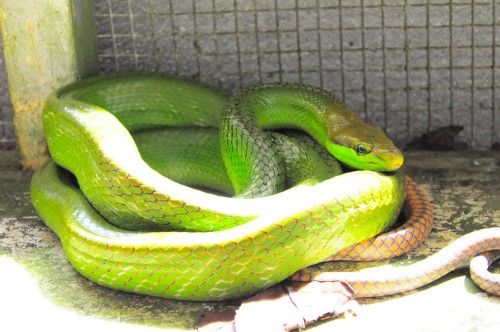
Red – tailed Racers inhabit the tropical forests. These tree living snakes are active at day and spend the largest part of their life on trees. They have powerful, rough scales which are ideal for climbing and moving in trees. On their back, they have small, green smooth scales with red or brown tail and a dark line horizontal across its eyes. These types of snakes seldom descend on the ground and they feed almost exclusively on birds. When stressed, they may inflate a bag of air in its neck, making them appear larger in size.
Green Whip Snake

These snakes have enlarged teeth at the back of their jaws that can administer a rather painful bite. Lizards and birds form the mainstay of their diet. They are slender – about 2 cm thick, and have a length of about 1.5 to 2 meters. Their tails are long, used mostly to hold on to trees while reaching for preys. The green whip snakes have two larger teeth at the back of their mouth; these teeth will permit toxic saliva to penetrate wounds to immobilize prey which is then rapidly swallowed. Once the prey is completely in the snake’s body, the whip snake searches for a resting place – usually in the highest point of a tree. Their behaviour towards humans is neutral and the snake usually goes to the other end of the terrarium.
The Importance of Snakes:
Snakes are vital in controlling crops damaging preys such as rats and mice. Some, like the sea snakes and pythons, are caught extensively as food in Asia but, although most are probably edible, snakes are not widely hunted for their meat. Their skin though is used widely for belts, bags, and shoes. Venom is removed from snakes for use in treating certain diseases and to make antivenin for snakebites.
Snakes are one of the several groups of reptiles. They have long, slender bodies, no legs, no eyelids, no ears, and are covered in back-folded skin sections called scales. Like other reptiles, they use their surrounding heat to regulate their body temperature. Snakes’ flexible bodies allow them to stretch out to warm themselves, curl up to conserve body heat, or just warm a particular part of their bodies. They are found on land and in water, as well as in every habitat imaginable, except where it is very cold.
Do you know that some snakes can move faster than humans?
Black Mamba can travel at speeds up to 12 mph compared to the average human who can run at about 6-8 mph. However, snakes on the whole are slower than humans as they have less stamina.
Interesting Facts about Snakes:
• An angry snake often curls up in an *S’ shape
• If a cobra raises its head, it doesn’t mean it is angry, unless the angry cobra expands its head
• Snake’s eyes are covered by clear scales rather than movable eyelids; therefore, their eyes are always open
• Snakes have thermal vision, they see heat and movements
• Snakes cannot taste anything, and does not chew
• They repeatedly flick out their narrow, forked tongue to bring odours to their sense organ in the mouth
• Snakes might not eat also during shedding
• Snakes use Lateral Undulation, moving in wave like motion, in water and on land
• Viper on the other hand will side-wind or move its body segments in one direction while remaining contact with the ground
Hopefully with more awareness raised on our gliding cohabitants here, more compassion hence more lives can be spared on one of the most misunderstood creatures in our planet! HAPPY WORLD SNAKE DAY!
Posted in Photos |
Has anyone seen this bird?
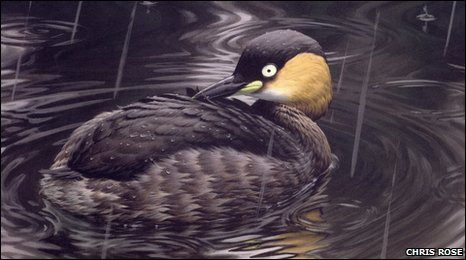
I’ve never seen this bird before, have you? Actually, someone last saw it in 1985 in Madagascar’s Lake Alaotra. And just recently, experts has confirmed that it has gone extinct due to human poaching and other predators. Another beautiful species is lost forever…
Will we get to see more species disappearing? Oh yeah, of course.. that depends on you and me and WE are about to DO next …
Goodbye bird ( Tachybaptus rufolavatus ) …
Tags: bird conservation, extinct species, extinction
Posted in Birds, Latest News |
Gecko Eggs!

Guess what.. our green-eyed geckos had lay some eggs… now we wait for them to hatch!
Tags: eggs, gecko, green eyed gecko
Posted in Reptiles |
Changi Butterfly Garden featured in Architect Concept
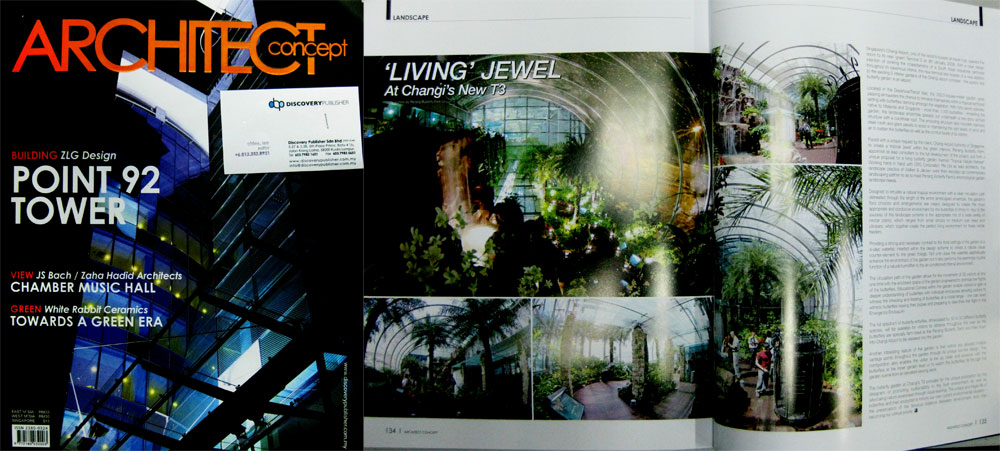
Changi Airport's T3 Butterfly Garden featured in Architect Concept magazine.
In 2008, we had consulted Changi Airport in creating a natural butterfly garden, and the project was recently highlighted in the landscaping section in the Architect Concept magazine. Thank you for featuring us!
Tags: 2008, airport butterfly garden, airport garden, changi airport, changi butterfly garden, changi t3, t3 butterfly garden
Posted in Butterflies, Habitat, Latest News |
Earth Hour 2010
You know what to do. Switch off those lights at 8.30pm on 27th March 2010 (Saturday).
Here’s an Earth Hour turtle poster:
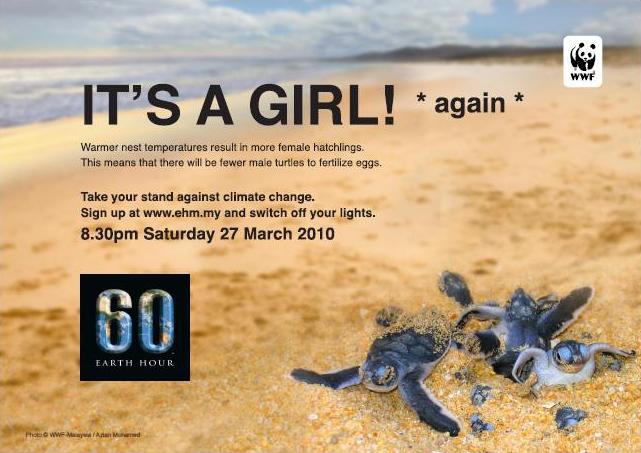
Earth Hour - It's A Female Turtle Again
Download more here.
Posted in Climate Change |
Some Butterflies Do Listen To You
Did you know that some butterflies have ears?
Scientists have just learnt more about the ears on the Morpho peleides…
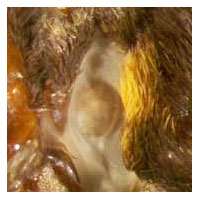
Here’s what the scientists said:
The ears of insects exhibit a broad functional diversity with the ability to detect sounds across a wide range of frequencies and intensities. In tympanal ears, the membrane is a crucial step in the transduction of the acoustic stimulus into a neural signal. The tropical butterfly Morpho peleides has an oval-shaped membrane at the base of the forewing with an unusual dome in the middle of the structure. We are testing the hypothesis that this unconventional anatomical arrangement determines the mechanical tuning properties of this butterfly ear. Using microscanning laser Doppler vibrometry to measure the vibrational characteristics of this novel tympanum, the membrane was found to vibrate in two distinct modes, depending on the frequency range: at lower frequencies (1–5 kHz) the vibration was focused at the proximal half of the posterior side of the outer membrane, while at higher frequencies (5–20 kHz) the entire membrane contributed to the vibration. The maximum deflection points of the two vibrational modes correspond to the locations of the associated chordotonal organs, suggesting that M. peleides has the capacity for frequency partitioning because of the different vibrational properties of the two membrane components. Extracellular nerve recordings confirm that the innervating chordotonal organs respond to the same frequency range of 1–20 kHz, and are most sensitive between 2 and 4 kHz, although distinct frequency discrimination was not observed. We suggest that this remarkable variation in structure is associated with function that provides a selective advantage, particularly in predator detection.
You can read more about it here.
Posted in Butterflies |