World Snake Day at Penang Butterfly Farm
In conjunction with World Snake Day that falls on the 16th of July every year, Penang Butterfly Farm would like to celebrate the occurrence of this day by creating awareness and highlighting the importance of snakes.
Due to urbanization hitting up in Penang and the generally bad impression the public has of snakes, snakes have been dying off at alarming numbers. Snakes losing their habitat often find new snake dens in gardens, chicken pens or basements. This puts snakes in danger of coming into contact with humans as almost all such encounters will result in the snakes being killed on sight. There have been instances where snakes “trespass” on human habitations causing some destruction and having their heads smashed off as a result. Vigilante such as this can be avoided if people are more aware of snake behaviours. The general consensus is fear, people kill to protect themselves from what they see as threats.
Despite appearances, snakes are quite harmless. Most snakes are not venomous and would escape rather than attack when confronted with humans. Let us in this day look at our slithery friends in a different glance as Penang Butterfly Farm celebrates World Snake Day with our gliding pals in enclosure!
Mangrove Snake

Also known as Cat-eyed snakes, they are generally thin, long bodied with large heads and large eyes. They vary greatly in pattern and color. Many species have banding, but some are spotted and some are solid coloured. Colours are normally black, brown, or green with white or yellow accents.
They are primarily arboreal, nocturnal snakes that prey on various species of lizards, birds, and rodents. Their venom toxicity differs from species to species, but it is not considered life threatening to humans.
Wagler’s Pit Viper

One of the venomous pit viper species native to Southeast Asia, they are sometimes referred to as the temple vipers due to their abundance in the Temple of Azure Cloud in Malaysia. These tree dwellers are active at night and appear sluggish as they remain motionless for long periods of time waiting for preys to pass by. Nevertheless when preys do pass by or of disturbed, they can strike quickly. Their primary diet consists of rodents, birds, and lizards. The pits on the sides of the head are capable of detecting temperature difference of as little as 0.003 degree Celsius. Their venom is non fatal to humans.
Red – tailed Racer
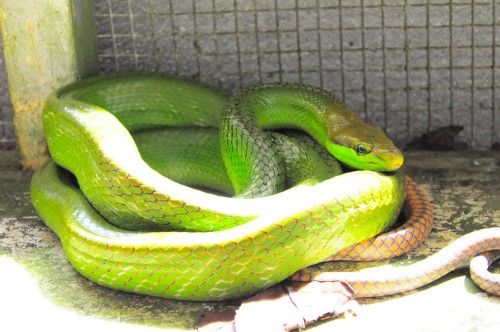
Red – tailed Racers inhabit the tropical forests. These tree living snakes are active at day and spend the largest part of their life on trees. They have powerful, rough scales which are ideal for climbing and moving in trees. On their back, they have small, green smooth scales with red or brown tail and a dark line horizontal across its eyes. These types of snakes seldom descend on the ground and they feed almost exclusively on birds. When stressed, they may inflate a bag of air in its neck, making them appear larger in size.
Green Whip Snake

These snakes have enlarged teeth at the back of their jaws that can administer a rather painful bite. Lizards and birds form the mainstay of their diet. They are slender – about 2 cm thick, and have a length of about 1.5 to 2 meters. Their tails are long, used mostly to hold on to trees while reaching for preys. The green whip snakes have two larger teeth at the back of their mouth; these teeth will permit toxic saliva to penetrate wounds to immobilize prey which is then rapidly swallowed. Once the prey is completely in the snake’s body, the whip snake searches for a resting place – usually in the highest point of a tree. Their behaviour towards humans is neutral and the snake usually goes to the other end of the terrarium.
The Importance of Snakes:
Snakes are vital in controlling crops damaging preys such as rats and mice. Some, like the sea snakes and pythons, are caught extensively as food in Asia but, although most are probably edible, snakes are not widely hunted for their meat. Their skin though is used widely for belts, bags, and shoes. Venom is removed from snakes for use in treating certain diseases and to make antivenin for snakebites.
Snakes are one of the several groups of reptiles. They have long, slender bodies, no legs, no eyelids, no ears, and are covered in back-folded skin sections called scales. Like other reptiles, they use their surrounding heat to regulate their body temperature. Snakes’ flexible bodies allow them to stretch out to warm themselves, curl up to conserve body heat, or just warm a particular part of their bodies. They are found on land and in water, as well as in every habitat imaginable, except where it is very cold.
Do you know that some snakes can move faster than humans?
Black Mamba can travel at speeds up to 12 mph compared to the average human who can run at about 6-8 mph. However, snakes on the whole are slower than humans as they have less stamina.
Interesting Facts about Snakes:
• An angry snake often curls up in an *S’ shape
• If a cobra raises its head, it doesn’t mean it is angry, unless the angry cobra expands its head
• Snake’s eyes are covered by clear scales rather than movable eyelids; therefore, their eyes are always open
• Snakes have thermal vision, they see heat and movements
• Snakes cannot taste anything, and does not chew
• They repeatedly flick out their narrow, forked tongue to bring odours to their sense organ in the mouth
• Snakes might not eat also during shedding
• Snakes use Lateral Undulation, moving in wave like motion, in water and on land
• Viper on the other hand will side-wind or move its body segments in one direction while remaining contact with the ground
Hopefully with more awareness raised on our gliding cohabitants here, more compassion hence more lives can be spared on one of the most misunderstood creatures in our planet! HAPPY WORLD SNAKE DAY!
Posted in Photos
Very good information. Let save our snake!!!
Good information…let’s save our snake!!