Let’s Get You Started with #GrowMeToKnowMe
Thinking about saving the planet and don’t know where to start?
Start with a small potted plant.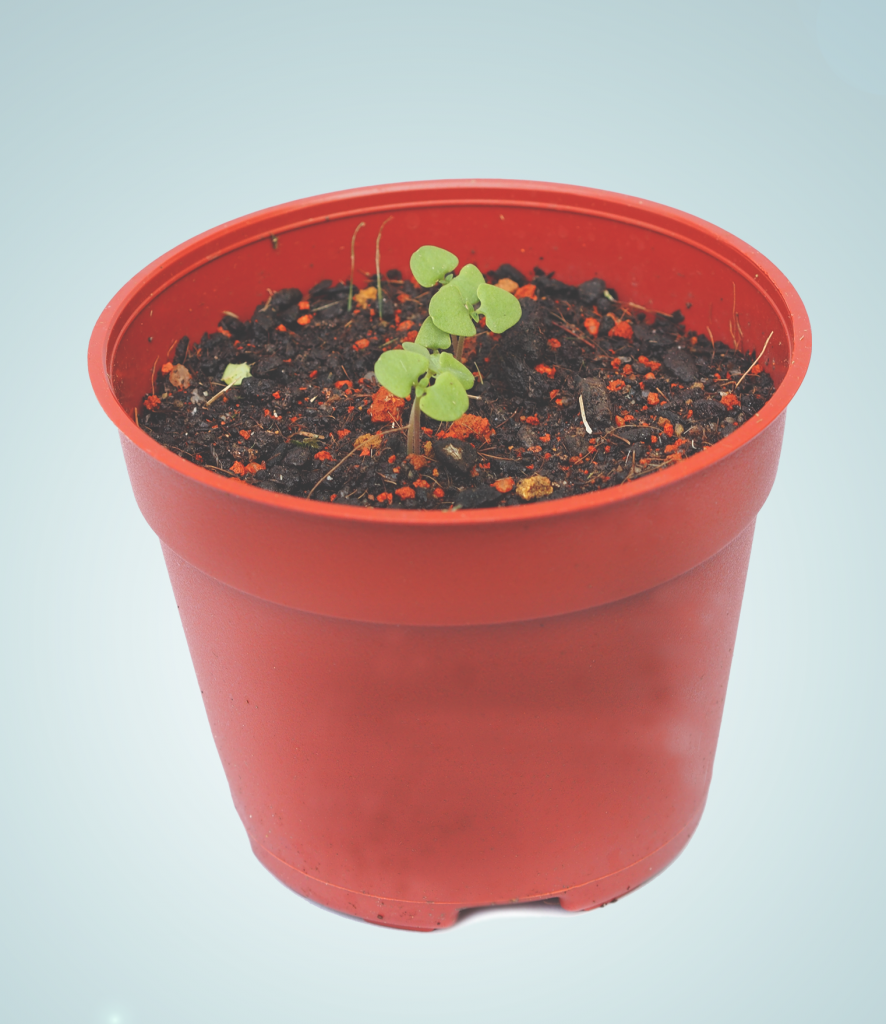
From 18 October to 17 November 2014, we are giving away 1000 plants in conjunction with our Grounbreaking Ceremony. To kickstart it, 200 plants were given away during the ceremony itself and followed by 20 plants each day at our souvenir outlet. More plants will be up for grabs at our booths during the Rock to Rock Run 2014 at Hard Rock Hotel Penang, at the Penang International Science Fair 2014 and during other events that we will be participating.
These are seedlings of nectar plants and food plants to several species of butterflies and we invite you to grow them in your own home. This is part of our responsibility as an eco-warrior and while we do our part, you will all be rewarded by the sight of “beautiful treasures of nature” fluttering around your backyard.
With this plant you may take part in the #GrowMeToKnowMe contest and stand a chance to win a Fujifilm Instax Mini 8 instant camera.
Here are the easy steps on how you can join the contest:
1. Snap a photo of your growing plant and post it on Instagram
2. Include a creative caption and identify the plant
3. Hashtag #GrowMeToKnowMe
4. Lastly, do not forget to tag us @penangbutterflyfarm
The lucky winners will be notified at the end of the campaign.
To make it a little bit easier, these are the packages where the seeds came from:

Other seeds are, sunflowers, African Marigold, Giant Zinnia, Sweet Basil and Balsam.
Now that you got your clues, it is just a matter of time until your plant grows at the right size for you to identify it.
Remember, changing the world doesn’t need to start with a grand gesture. Let’s change the world together, one plant at a time.
And don’t forget to get updates on our other social media sites about this campaign!
Posted in Climate Change, Events & Workshops, Mother Nature, Plants & Flowers, Promotions |
#GrowMeToKnowMe
First, we have a plant pot.
Then, we planted some love.
Out came the plants.
You might be asking by now, “What are these plants for?”
3 more days to go until we explain ourselves. For now, we are just too excited.
You should be too!

Posted in Latest News, Mother Nature, Plants & Flowers |
#GrowMeToKnowMe

#GrowMeToKnowMe
Something green is coming your way…
8 more days to go…
Stay tuned-in on our Facebook Page, Twitter, Instagram and Linkedin to know more.
Posted in Latest News, Mother Nature, Plants & Flowers, Promotions |
We’re blooming flowers of Bulbophyllum phalaenopsis
Haha.. can you guess what kind of plant this is?
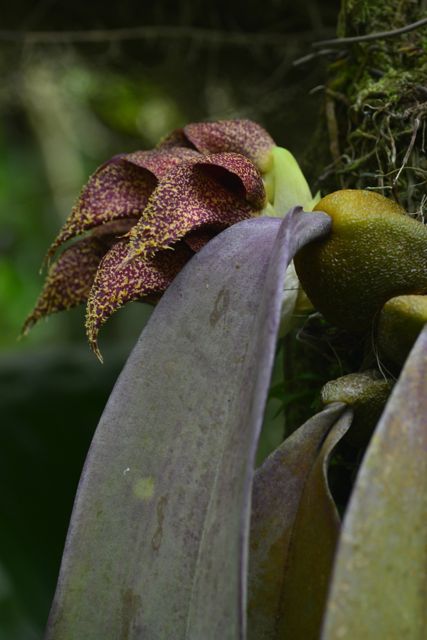
It is a kind of orchid… and it is so rare to see this orchid species blooming…
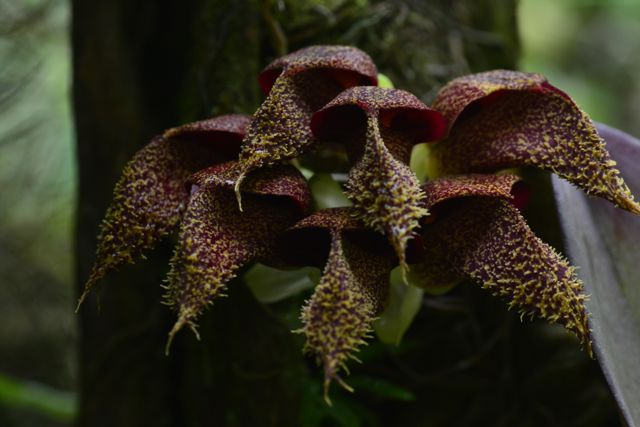
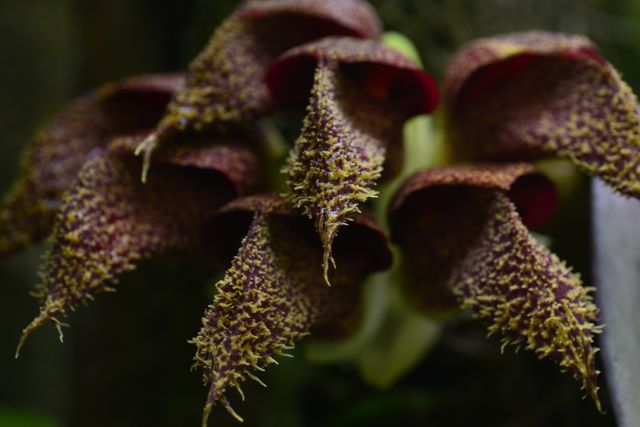
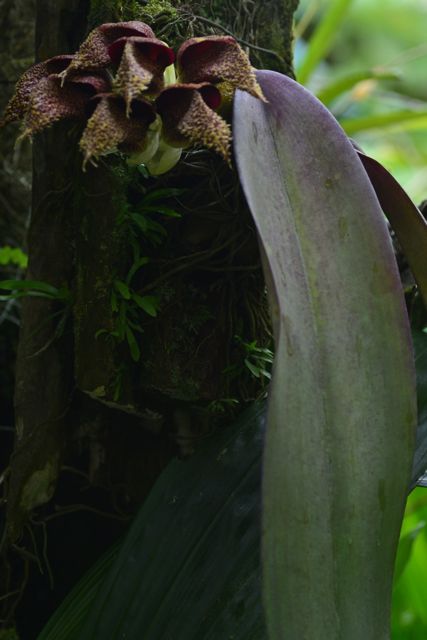
So until the next blooming season, quickly look for it in our butterfly garden… !
Posted in Plants & Flowers |
Malaysia Day Special : Bunga Raya
Painted Jezebel, September 15, 2011
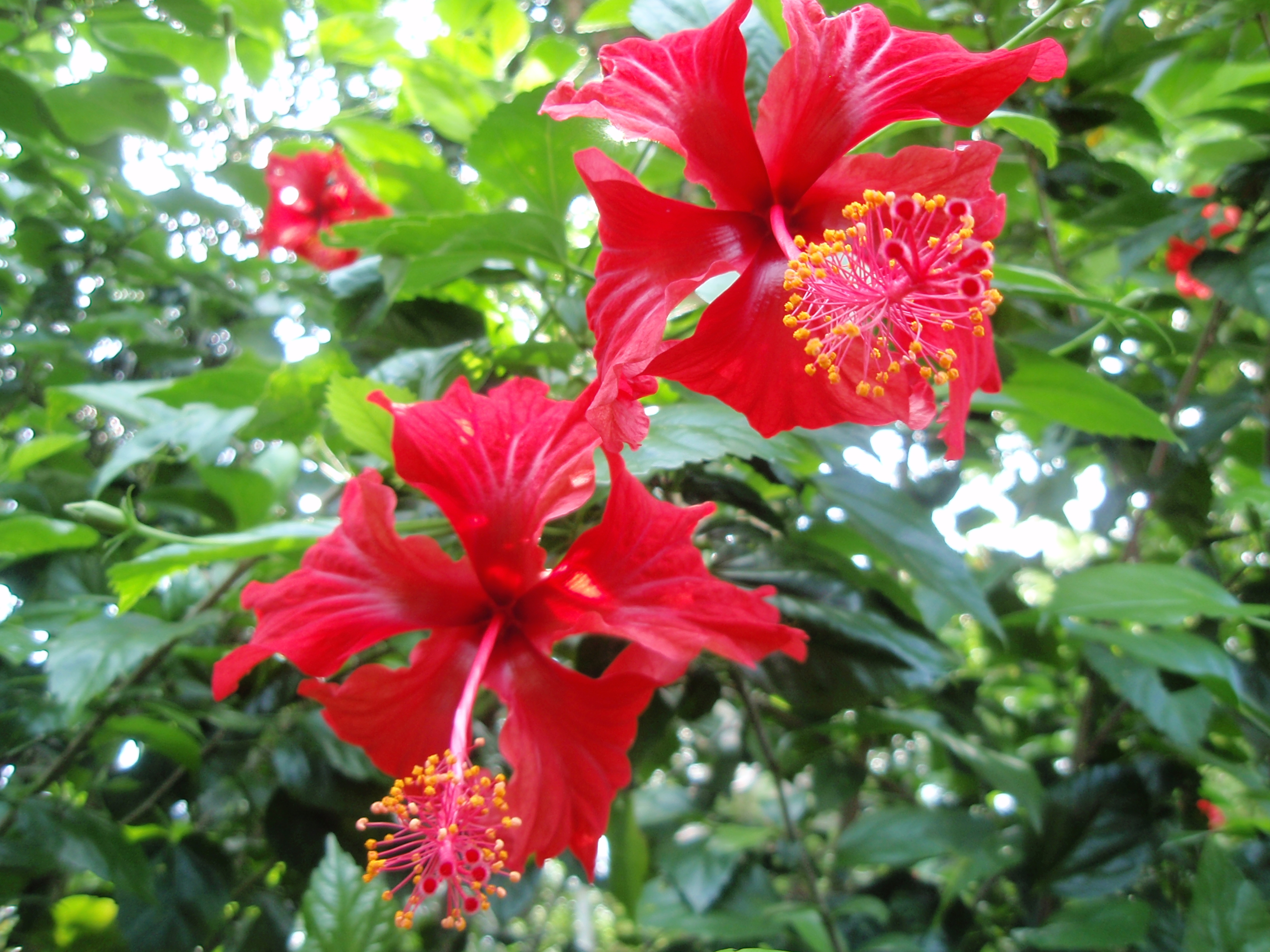
Its impossible to not notice their loud colour with brilliant anthers and stigmas shooting out of the petals like bursting fireworks. That’s our National Flower, the Hibiscus, or what we called Bunga Raya in Bahasa Malaysia. Let’s study a little Bahasa Malaysia, shall we? ‘Bunga’ means flower while ‘Raya’ means great, grand or large. And if we put in the affixes me- and -kan, ‘merayakan’ means to celebrate. A pretty glorious name for a flower, right?
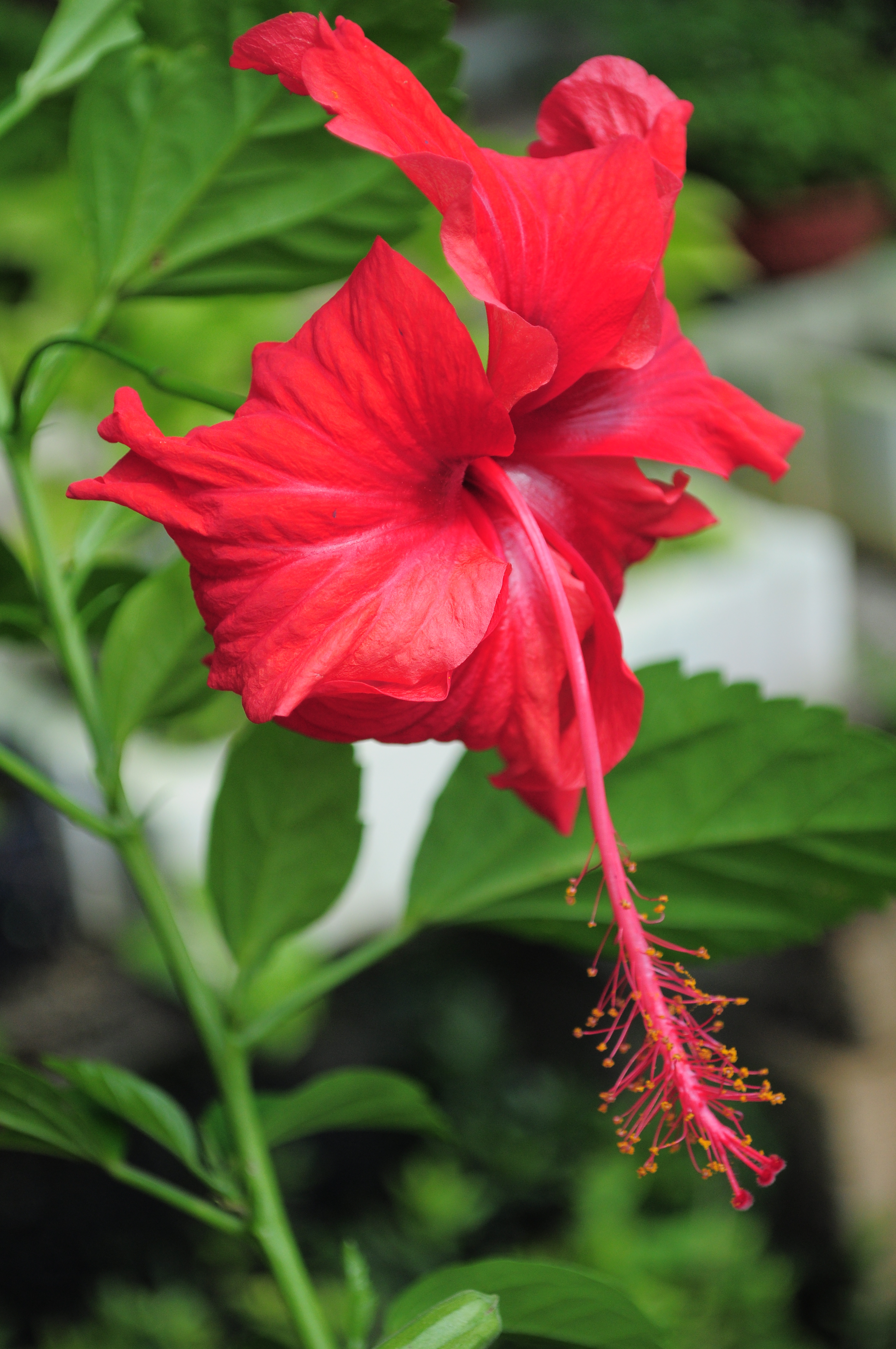
Bunga Raya is Malaysia’s national flower, as declared by Tunku Abdul Rahman on 1960 due to its abundance throughout Malaysia. Their bold red colour symbolizes courage, while the 5 petals symbolizes the 5 Rukun Negara (National Principles of Malaysia). Bunga Raya is believed to be introduced into Malaya around the 12th Century as an ornamental plant, possibly from China, as their scientific name literally means “Rose of China”. The origin of the plant is believed to be from Hawaii.
Bunga Raya are easily found in many parts of the world, particularly in the tropical countries, and thus, there are many different common names for Bunga Raya. In the Western World, they are called the Hawaiian Hibiscus, while they’re called ‘sembaruthi’ in Tamil, Guamamela in Tagalog, and in Indonesia, they’re known as “kembang sepatu” which means “shoe flower”.
Apart from being used as an ornamental plant, there are surprisingly a lot of interesting uses of Bunga Raya. The Chinese use it for medicinal purposes, while the Hindus use it to worship the goddess Devi. The flowers are actually edible and in the Pacific Islands, it is one of the ingredients in their salad!
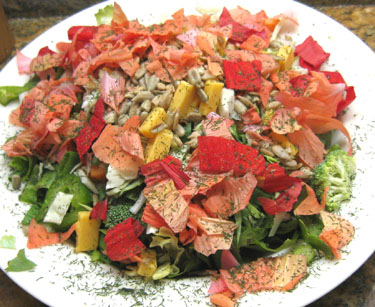
- Hibiscus Salad (Photo by Ginny Stibolt: http://www.sky-bolt.com/edibleflowers.htm)
Isn’t our National Flower interesting? Well, hopefully you’ll appreciate them more the next time you see them on the Ringgit notes and coins. Happy Malaysia Day to all Malaysians!
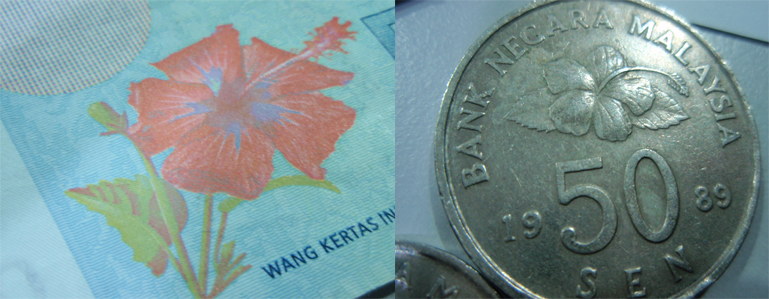
- Bunga Raya on Malaysian currency
Posted in Plants & Flowers |
A Butterfly Garden Opens At Changi T3 Airport
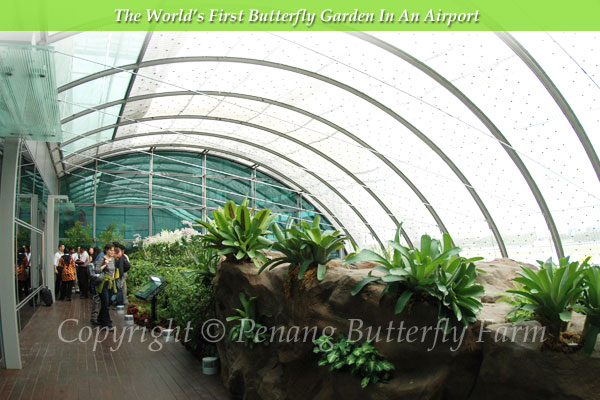
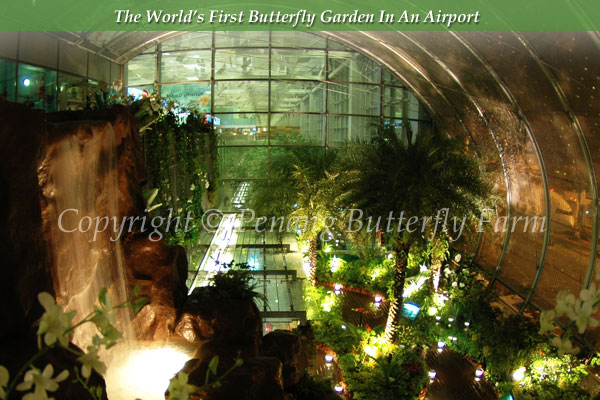
On Thursday, 28 August 2008, Singapore Changi Airport – the World’s Best Airport opened The World’s First Butterfly Garden In An Airport. Conceptualised by Butterfly House Consultancy Sdn Bhd, a subsidiary of Penang Butterfly Farm, the butterfly garden is designed to be a tropical nature retreat for passengers of Changi Airport Terminal 3’s Departure and Transit Mall to have a quick rest and relax from travelling. It is home to more than 1,000 free flying singapore butterflies, and close to 50 butterfly species native to Singapore and Malaysia were specifically selected to be bred in the butterfly garden.
The two-storey open-air enclosed garden is protected by a curved-shaped roof made out of high quality stainless steel mesh and unique glass windows, facing Changi Airport’s large airfield. It was designed in this manner to keep the butterflies in, maintaining exchange of wind and natural air which is vital to the survival of butterflies while maximising the butterflies’ flight activity.
Visitors walking inside this enclosure can view and enjoy the beautiful scenary of a waterfall which keeps the garden cool even at noon, and traversing a garden on timber walkway, the feeling being close to nature with exotic jungle plants and an unimaginable sight of colourful butterflies.
The media claimed that it is the most beautiful event that they had covered for Changi Airport. Mrs Lim Hwee Hua, Senior Minister of State for Finance and Transport who officially launched the butterfly garden, said:
“The Butterfly Garden is a unique attraction designed to complement Terminal 3’s nature theme and Singapore’s tropical garden image. Passengers will have a tranquil haven offering a respite from the stresses of traveling.”
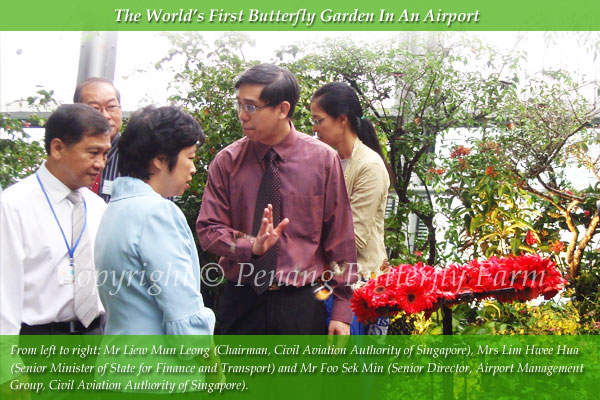
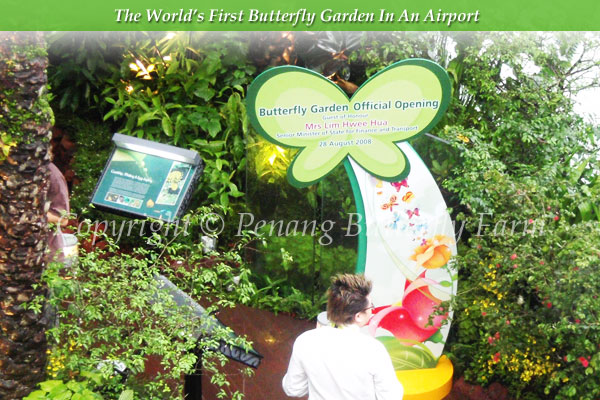
The technical representative from Butterfly House Consultancy Sdn Bhd further advised that each plant has been carefully choosen for each butterfly species survival. In a garden like this, the butterflies are actually living in a “butterfly paradise” as they can easily find nectar and thrive in the abscence of predators, therefore they have longer life-span and naturally, very friendly to humans.

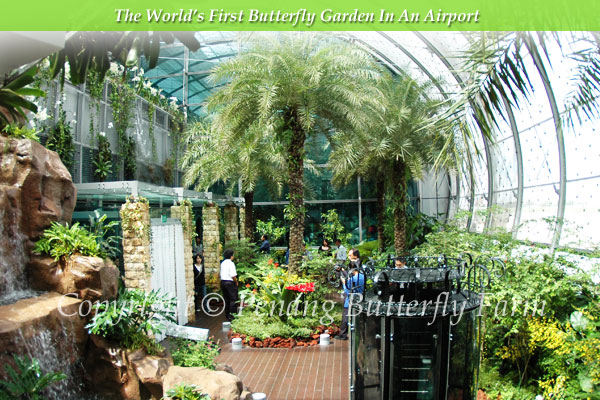
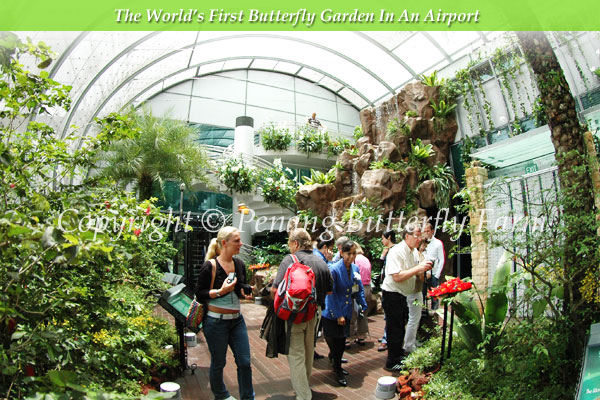
A stairway is to be found leading to the second level, where it brings visitors deeper into their imagination. As visitors watch closely on the leafs of plants on the balcony, creatures that are almost hidden emerge before one’s eyes causing a surprise. It seems the garden not only keeps butterflies alive, but alive with creatures of camouflage such as stick insects and leaf insects. The sight from the butterfly garden’s balcony is absolutely relaxing for its visitors; standing at the height of its waterfall, one can feel in awe with its beauty.
Related links:
Butterfly House Consultancy Website
Changi Airport Colours Website
Tags: airport butterfly garden, airport garden, changi airport, changi butterfly garden, changi t3, t3 butterfly garden
Posted in Butterflies, Habitat, Latest News, Plants & Flowers |
Ever Seen Ants That Look Like “Berries” ?
I was just updating myself with some news from the National Geographic, and there was this interesting post about mimicry of a fruit plant by parasitic worms.
For many species of insects, mimicry is one of the key to survival. However in a latest findings by an insect ecologist – mimicry caused by parasites can be life torturing for some insects such as ants.
Here’s what I mean when you see these photos:

This tropical ant of the species Cephalotes atratus is infected with a parasitic roundworm that makes its bulbous rear end, called a gaster, look like a juicy red berry. Researchers believe the parasites transform the gasters to trick foraging birds into eating the ants. Birds poop out parasite eggs, allowing the worms to spread to new ant colonies.
The Cephalotes atratus ants are common in the tropical forest canopy in Central and Latin America. If knocked off a branch, they can glide toward the tree trunk, grab hold, and climb back up.
- photos by Steve Yanoviak and National Geographic
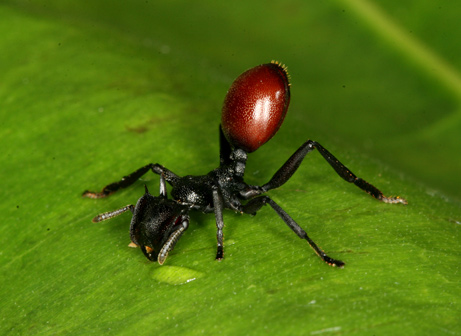
Insect ecologist Steve Yanoviak says the finding is the first known example of fruit mimicry caused by a parasite in the world.
Such as an amazing discovery, isn’t it? Too bad for the ants, they enjoy feeding on birds’ feces which contain those worms that causes this strange life cycle to go on. Well, that’s nature!
You can read the full story here:
http://news.nationalgeographic.com/news/2008/01/photogalleries/ant-pictures/index.html
Tags: ants, berries, Insects, mimicry, parasites
Posted in Insects, Latest News, Plants & Flowers |