Weird ways of using insects.
Painted Jezebel, December 15, 2011
Insects are among the most diverse group of animals, with about over 1 million species described. And aside from the diversity of their species and characteristics, there is such diversity in how we human utilize them. I’m sure many of you are familiar with bee-keeping for bee products, and insects as biological controls for unwanted plants, or even insects being eaten! Here’s a few more that might be new to you… but they sure are weird!
1. Bees stings and medicine.
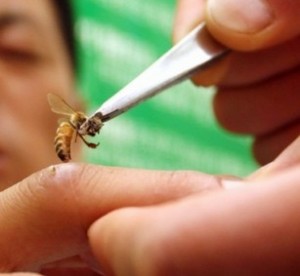
source: altmedicinezone.com
Have you heard of Bee Venom Therapy? While generally people avoid bees because of the fear for their sting, here’s a therapy that forces bees to sting you. Ouch! It may sound awful, but bee venom is known to have many properties that are medically beneficial. This includes anti-inflammatory agents (to reduce inflammation), as well as anti-bacterial properties (to kill bacteria).
Bee Venom Therapy is believed to be good for multiple sclerosis, Lyme disease and chronic fatigue. In the older days, they are used to treat arthritis, back pain and skin diseases. In this therapy the bees are stimulated to sting at affected area or what they call acupuncture points. The success of this therapy is very much debated and there are research proving its ineffectiveness. Well, effective or not, isn’t it weird?
2. Bees and wars.

source: seabeesmuseum.com
Bees seem to be useful in so many ways, not only human take advantage of their hard-working character to produce honey, we force them to sting as a therapy and in ancient time, their whole hive are used as ‘bombs’. Apparently, in history, the Romans catapult in bee hives to their enemies, unleashing angry bees as a distraction. The same strategy were used by the English armies and and Portugese. Some others set bee hives in front of their fortress or as barricades in their cities as a defence strategy against advancing enemies.
3. Dermestid beetles and skulls.
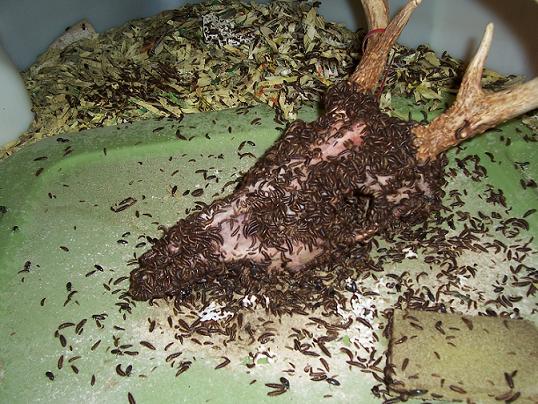
Cleaning up! (source: wattsskulls.com)
So here’s a combination of two creepy things: skulls and flesh-eating beetles. Ever wondered how museums, exhibitions and suppliers clean up their animal skull or skeletons? Yeap, they leave that job for the Dermestids beetles to do. Dermestid beetles are insects of the family Dermestidae. However, not all the members of this family are flesh-eaters.
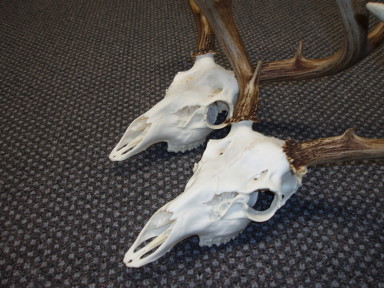
After (source: bonesandbugs.com)
Their ferocious appetite for dead meat are particularly useful for skull cleaning as they would clear every inch of flesh, even in the deepest and difficult angle. All this without causing damage to the bones, the way human tools would. They are even bred by exhibitors and suppliers just for this purpose. But to reduce the creeps, these Coleopterans feed only on dead flesh and do not seem to have the appetite for living things. Phewh!
4. Beetles and accessories.
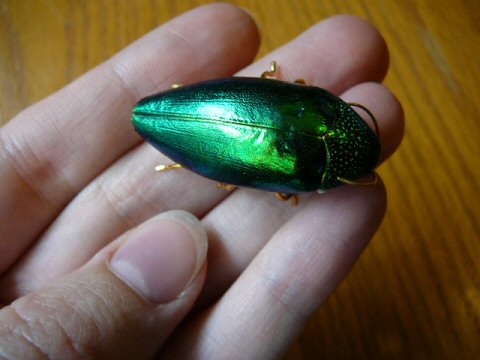
Beetle Brooch (source: weird-websites.info)
There is a family of beetles known as Jewel beetles, which are scientifically known as family Buprestidae. They are named so because of beautiful metallic colouration, which resemble jewels. They have huge varieties in colour including emerald green, metallic blue, red, yellow, purple… you name it. Ironically, because of the jewel-like features of these Jewel beetles, they are also made into jewellery. Literally out of the elytra (the hard forewings) of the bugs themselves. They are made into brooches, earrings, rings and pendants.
5. Insect fights.
Insect fights had been part of the cultures in Asia, including China, Japan, Thailand, Vietnam and Philippines. In these places, insects such as stag beetles, rhinoceros beetle and crickets are kept as pet for this purpose. Cricket fighting dated way back to the Tang Dynasty of China (618-907). Beetle fightings are especially interesting and it involves only male beetles.At the tournament, the beetles are triggered to battle by placing a female before them, or by noise-maker which imitates the female’s call for mating. The winners are determined by one insect pushing its opponent out of the ring, or when its opponent is being flipped over.
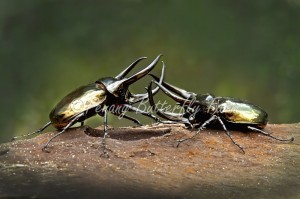
Its like mini sumo, isn’t it?
Posted in Insects, Natural Disaster |