3 Exciting Activities For You
Are you planning a trip to Penang Butterfly Farm?
Here are the activities that you have to watch out for.
For an updated time schedule, don’t forget to check the schedule board at the Entrance Foyer.
Posted in Butterflies, Events & Workshops, Insects |
Malaysian Champions
Painted Jezebel, September 14, 2012
Its the time of the year when we remember the formation of our beloved country Malaysia. In this Malaysia Day edition, we would like to highlight some ‘little Malaysians’ that has made it into the world records. Lets take some time to appreciate our local champions, shall we?
1. The Longest Stick Insect
Apparently the world’s longest stick insect is a Malaysian species, known as Chan’s Megastick or Phobaeticus chani. One of these megasticks made it all the way to Natural History Museum of London, measuring 22.3 inches (56.7 cm) with its legs all stretched out to the front, like this:
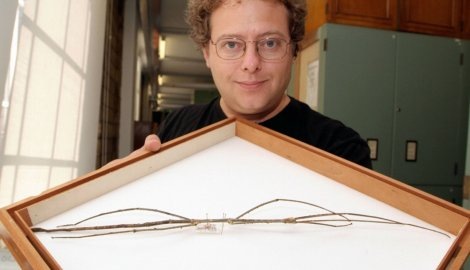
source: fox news
Chan’s Megasticks are found in Sabah, our beautiful “Land Below the Wind” and scientists announced this species to be among the top 10 new species described in 2008. Thanks for making us proud!
2. The Heaviest Stick Insect
Durians are not the only spiky prickly things in the forest of Malaysia. Meet one of the heaviest stick insect, the Thorny Stick Insect or Heteropteryx dilatata in scientific tongue. Some refer these creatures as the Jungle Nymph. The females of these species are able to weigh around 50-60 grams, which is about the weight of ½ cup of sugar. The females could grow to around 6 inches (15 cm) and they are twice the size of the males. You might wanna think twice before handling these creatures… just look at the spikes! 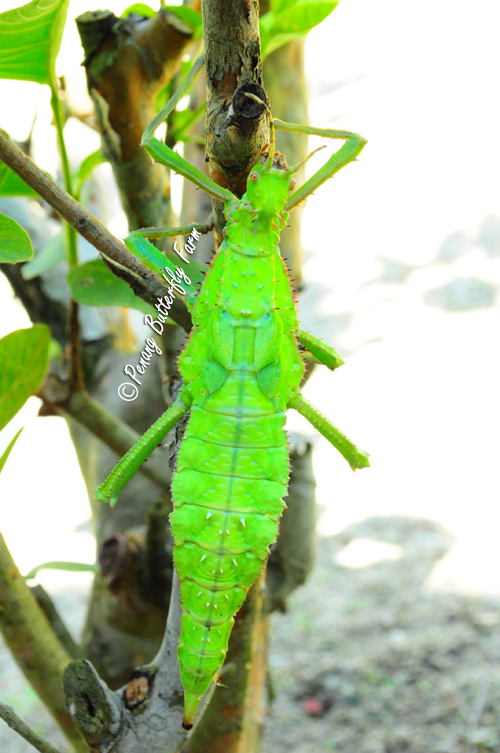
3. The Largest Leaf Insect
The Leaf Insects, as the name suggest, look exactly like leaves and that is where they usually literally hang out –among the leaves! Malaysia is home to the largest species of leaf insect, known as Phyllium gigantum. Members of this species could grow up to 5 inches long and about 3 inches wide. Apart from looking like leaves, they eat leaves too and not only that, they tend to act like one! When the wind blows, these little actors will sway like how the leaves would. So the next time you hike into Malaysian forest try spotting them if you can. 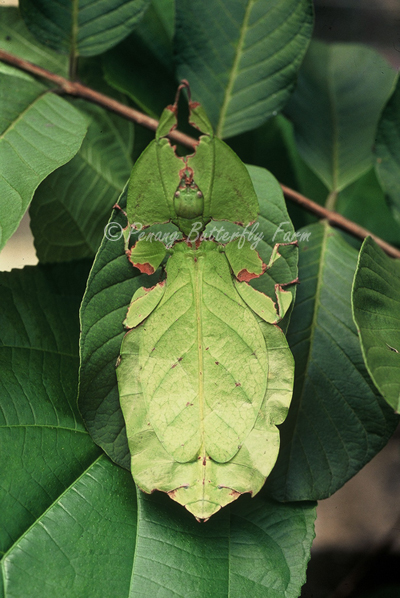 4. The Largest Cicada
One of the largest cicada (and possibly the loudest or most annoying) comes from Malaysia. We certainly do have many champions, don’t we? The champion’s name is Pomponia imperatorial or the Empress cicada. With their wings spread out, they measure 20cm (wingspan) and their body can be around 3 inches long. They are brown in colour and can be a quite an irritating house visitor as they can be quite hysterical around lights and can be very noisy. Someone should check if they’re the world’s noisiest cicada.
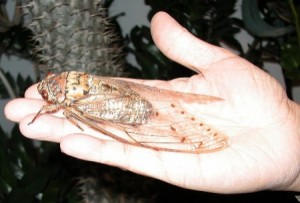
Source: www.agr.gc.ca
These are just a few examples of Malaysian champions of nature. Malaysia is not only diverse in culture and races but also rich in biodiversity. There are so much more to discover and perhaps someday we will receive more surprises when researches find more little champions. may this Malaysia Day will not only remind us the roots of our country but also remember to appreciate how rich our mother nature is. Happy Malaysia Day!
Posted in Insects |
Gynandromorph Rajah Brooke’s Birdwing!
Painted Jezebel, August 10, 2012
Penang Butterfly Farm has a big surprise yesterday (9 August 2012) when a rare butterfly was spotted! Well, Rajah Brooke’s Birdwing may not be so rare but a gynandromorph one, sure is very rare!
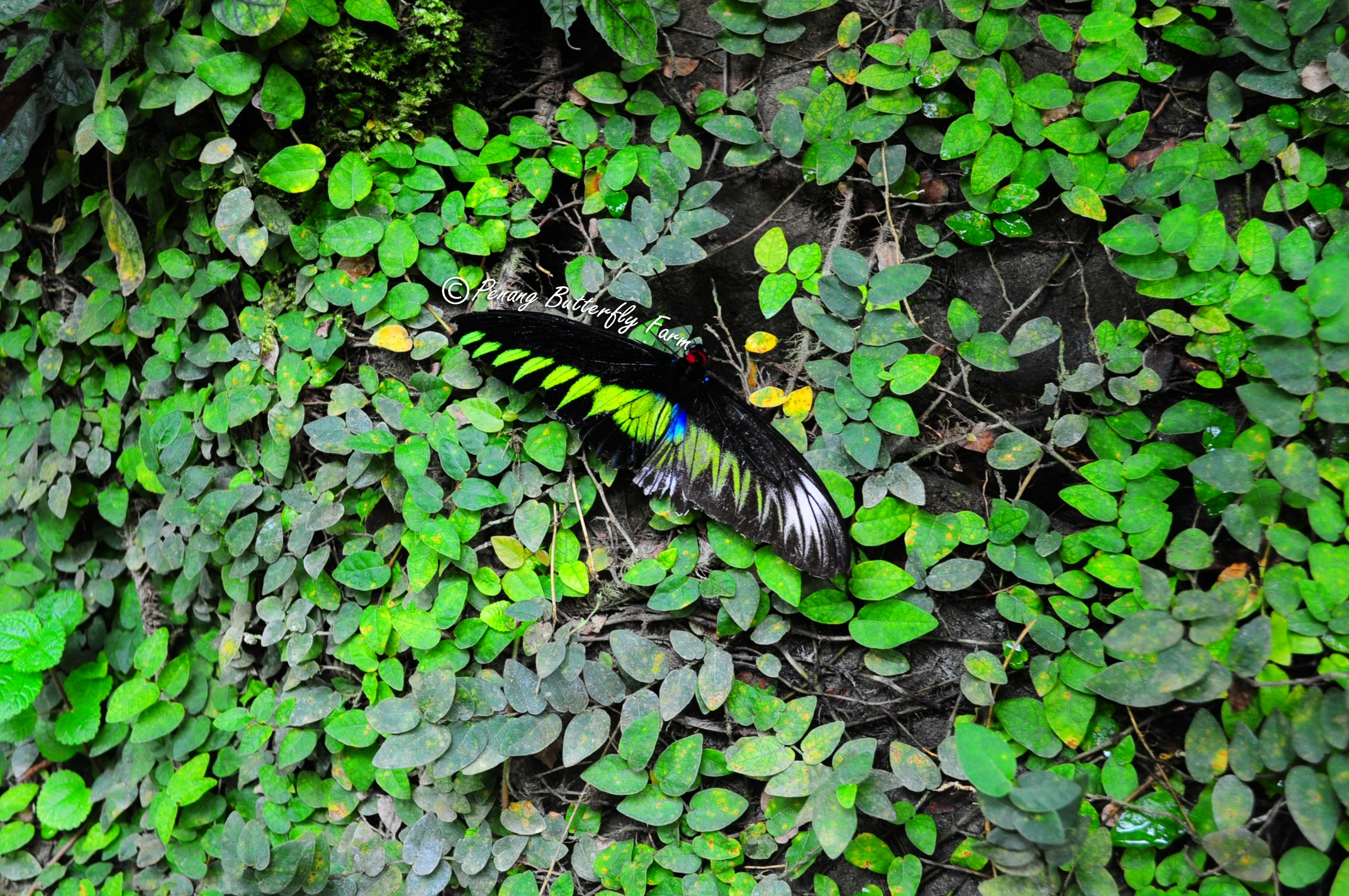
What is “gynandromorph”?
Gynandromorph refers to organisms that display both female & male traits. In other words, they are both male & female. This happens to butterflies but chances of finding them are rare. Here’s the comparison to the normal Rajah Brooke’s birdwing:
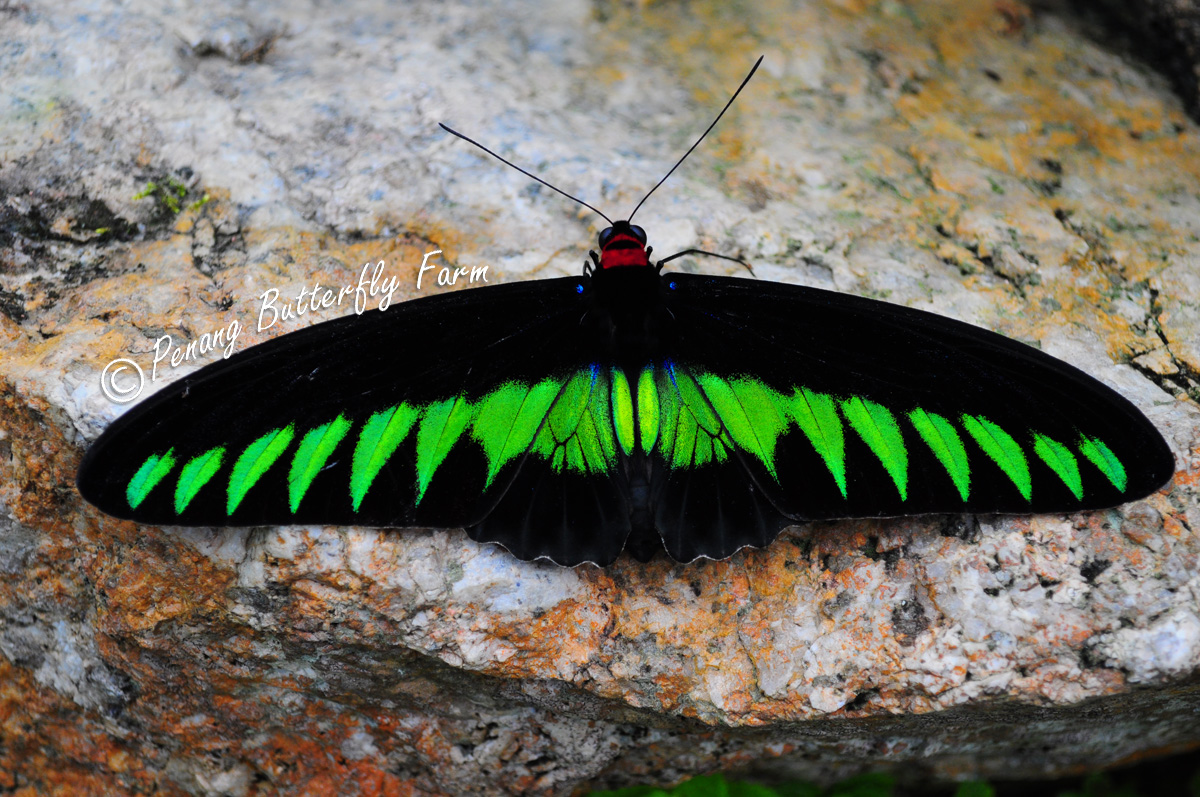
Male Rajah Brooke’s Birdwing
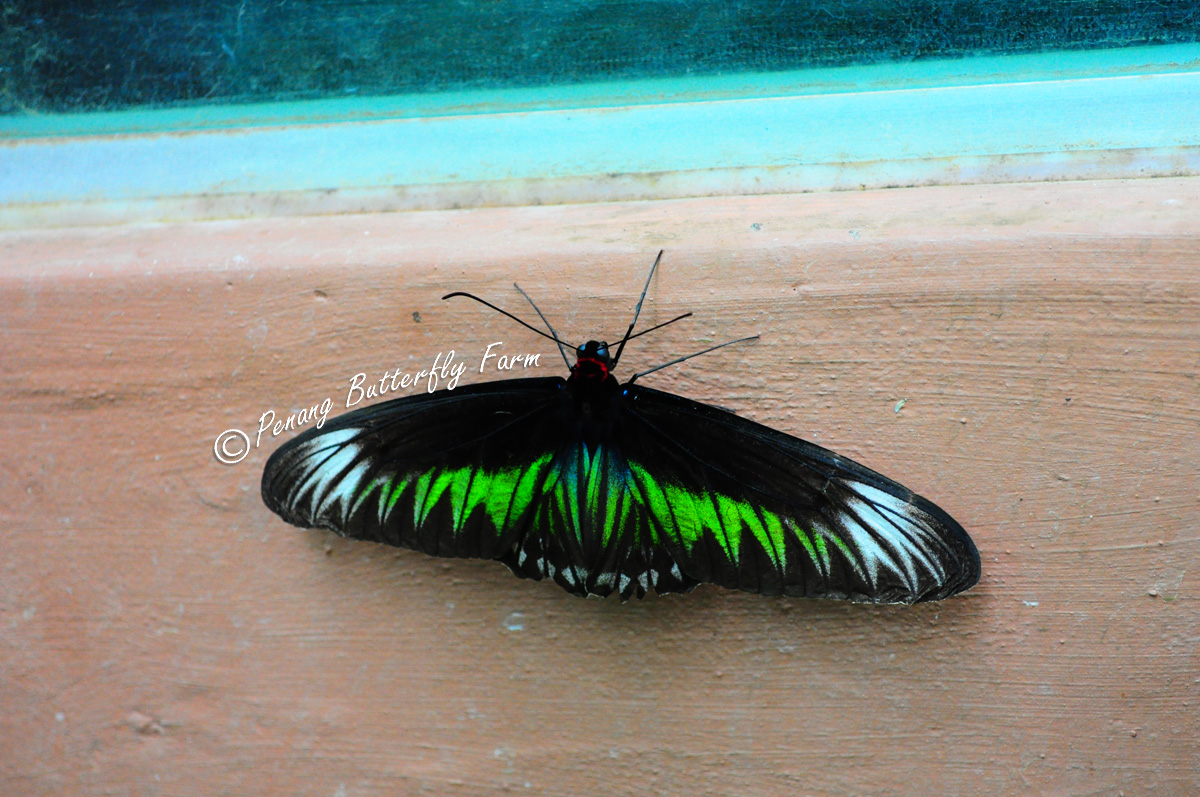
Female Rajah Brooke’s Birdwing
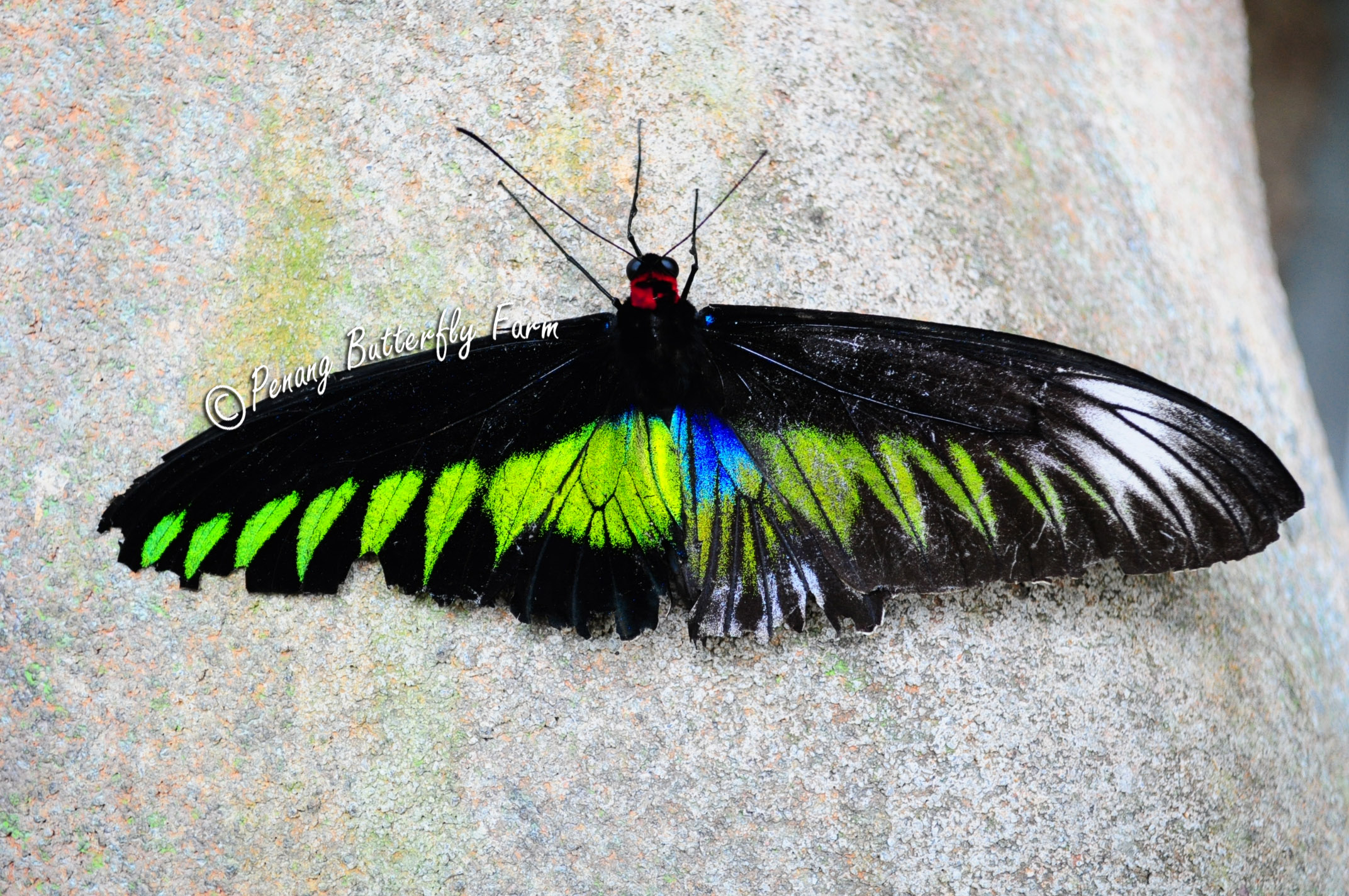
Gynandromorph Rajah Brooke’s Birdwing
Notice that the gynandromorph butterfly has the male feature on one wing and the female features on the other. This even applies to its abdomen, where it is male on one half and female in the other.
Gyandromorph butterflies are known to be infertile. That means they are unable to reproduce.
Nature comes in all shapes and sizes. Isn’t nature just amazing?
Posted in Butterflies, Insects, Latest News |
Blessing in Disguise
What is ‘Camouflage’ ?
The word ‘Camouflage’ which originates from French which means ‘disguise’ or ‘concealment from disguise’ has been in use since the early 20th century. The one and only thing that revolves around the real life is the art of survival. Thus, the usage of bio-mimicry among organisms has become an important mechanism to avoid exposure. By camouflaging, animals blend with their natural surroundings to a level where their presence is almost undetectable. Insects too come under these category of organism where blending occurs via the change of phenotypes (body colours and shapes). Some insects have unusual patterns genetically which makes it impossible for us to see its body shape against a background. On the other hand, some insects have body structures which carry the resemblance of objects present in their environment such as leaves, branches, sticks, flowers and tree bark. This mechanism has been known to be one of the most profound method used by animals and insects to protect themselves from possible predators.
The art of camouflaging fall into three categories:
a) Crypsis – Act of blending in with their surrounding
b) Mimesis – Resemblance of the objects around their environment
Now, since you have received some informational dose on the basic information related to camouflaging, it’s now time to introduce to you the ‘Phantom’of the insect kingdom! Yes! We are referring to the insects that camouflage themselves.

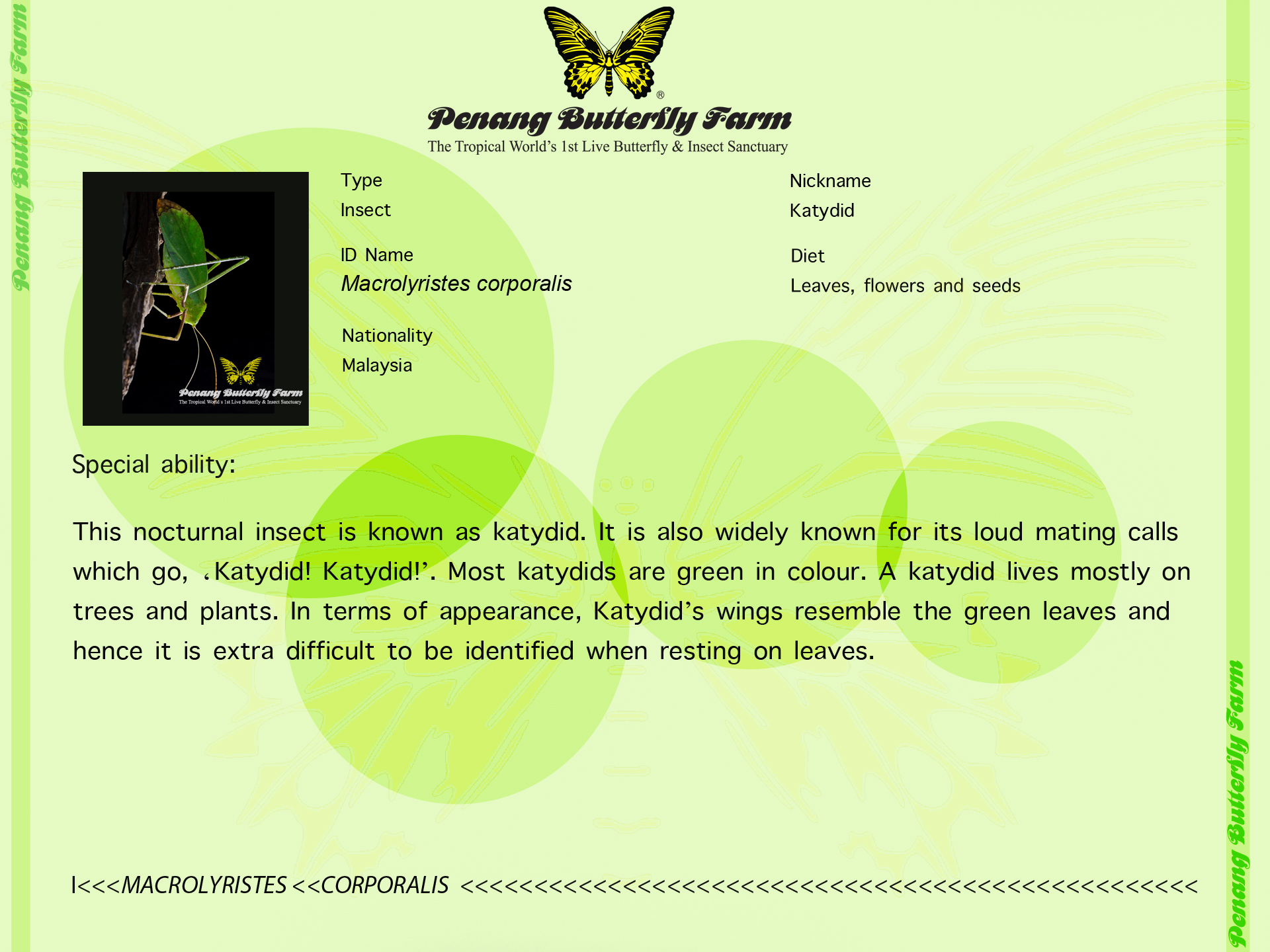


Now that you have met the “Phantom” of the insect kingdom, who said insects do not play tricks on us? Well, they do! They always did! And they always will in the name of survival of the fittest. Hope you learnt a lot from the post today.!
Posted in Insects, Mother Nature |
A Lady in Red
Have you ever seen this movie before?

He is a ladybug name Francis in A Bug’s Life movie. By looking at him, do you know that he is a male ladybug? In this movie, He always being teased by the other bugs and mistaken for a female. So, this time, we will discuss about this adorable insect – LADY BIRD
Actually, not all ladybirds are “LADIES”. They are both male and female ladybirds. They are not bugs or birds but they belong to the family of beetles. Ladybugs have a variety of colors like yellow, orange, maroon, and scarlet. So, how ladybirds got their name???
Ladybugs are really ladybird beetles. Their name actually is originated in the middle Ages in Europe. Long time ago, there is a crop disaster happened in a small farming village. Without any effective solutions, the farmers began to beg to the Blessed Virgin Mary to send help in this calamity. Soon, there is a change in the crops, the dying foliage started to revitalize and lastly the greenness of crops once again reappeared on the landscape. Then, the farmers saw many small red bugs with black dots on their concave bodies just like a battle soldier. These small red bugs were eating the destructive pest – aphids. The villagers cheer with saying “Our Lady’s bugs, Our Lady’s beetle”. Consequently, this small bug has become a very familiar pest killer and people give their name as ladybugs.
The ladybug is considered as a symbol of good luck and some cultures even rear them as pets in many countries in the world. Generally they are considered as useful insects, because most of them feed on aphids or scale insects, which are pests in gardens, agricultural fields and orchards. Due to ladybugs huge appetite for crop pests, most of the farmers and gardeners welcome the presence of ladybugs as a blessing and idolize the insect as a lucky symbol.
They can be found worldwide, with over 5000 species described. Both adults and larvae live on plants like roses, oleander, milkweed and broccoli. During the winter, the adults will hibernate in large groups, frequently in mountains at high elevations.
Behavior
Most of the ladybug species are predators. They can be found on the same plants feeding on the same species of prey. They also consume flower nectar, water and honeydew as their supplement. However, only a few ladybug species are plants eaters.
Brightly colored of these ladybugs is to warn their predator that they are distasteful and toxic. Ladybugs can also protect themselves by pretend dead. By pulling their legs up “turtle-style”, and normally release a small amount of blood from their legs. The bad smell and the visible look of death usually prevent their predators. After the threat of danger has passed, the ladybug will return to its normal activities.
In addition, their bodies are not able to handle extreme cold. They will look for shelter when the weather begins to turn cold. During the winter, they rest quietly and this period is called diapause. During diapause, the ladybugs do not grow and they can go without food for 9 months during diapause.

Ladybug and their foods – aphids. www.brisbaneinsects.com/brisbane_ladybirds/
Life cycle

www.willowridge.shs.k12.ny.us/WR_Teacher_Pages/sarnackij/Gr2%20Life%20Ladybug
Check out these fun facts about the ladybugs!!!
- Usually, the female ladybug is larger than the male.
- A female ladybug can lay more than 1000 eggs in her lifetime.
- The females will lay the infertile eggs as well as the fertile eggs.
- In average, the life cycle of a ladybug is between 4 to 6 weeks.
- A hard wing cover protects the ladybug’s fragile wings.
- A ladybug beats its wings 85 times a second when it flies.
- Ladybugs won’t fly if the temperature is below 13 degrees Celsius [55 F].
- The spots on a ladybug fade as they get older.
- Ladybugs use their antenna to smell, taste, and feel its way around.
- They can only see the difference between dark and light but they cannot see colors at all.
- Their larva is like mini alligator and their body adorned with spines.
- The ladybug do not bite, but they will pretend die with hides its legs and antenna under the body.
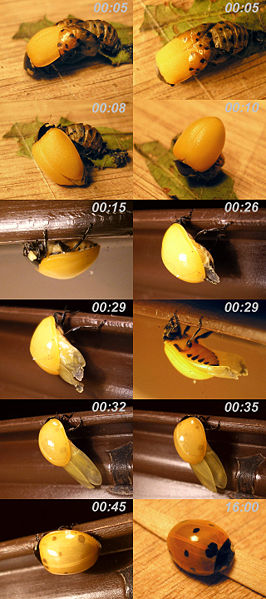
The emergence process of ladybug. www.kidzcraftz.ca/ladybugs.htm
Posted in Insects |
Love is in the air~
Painted Jezebel, February 14, 2012
Valentine’s Day is here once again. It’s the time of the year when you’ll get to see more roses, teddy bears, nicely wrapped chocolates and everywhere seems themed with cupids and heart shapes. Men planning their words and acts for romantic dates while women are all doll up for it. All these effort in courting done to impress partners are surprisingly happening to not only us human beings, but to insects too!
Smell good to look good

Many insects are known to release some kind of ‘perfume’ to them, called pheromone. Male butterflies are known to release pheromone to signal their presence to a female they pursue. We humans may not know how they smell like, but perhaps to the female butterflies, they smell like one of those Hugo Boss perfume.
As for moths, the females release their ‘Chanel No.5’ and the male who caught the scent will pursue her. Sometimes it’s a race between males, since whoever found the lady first, he’ll win her. In some species, the males, with their specialized antennae are able to track them from as far as 2 kilometres. Girls, you might want to ask the moths for some perfume selection tips.
What you see is what you get
The sight is one important feature or channel for insects to find their mate. Male butterflies will flutter around and when he recognize the patterns the female of their kind, they will proceed to their next move.

source: anneofcarversville.com
Visual signals are important to fireflies in finding their mate. The males will be flying around, flashing the ‘light bulb’ on their abdomen. Each species displays different flash patterns or pulses. The females are known to be picky and would only respond to flashes that attract her most. Outer appearance matters to some beetles, particularly the females (sounds familiar?). Male beetles are usually the more striking looking ones compared to females because of this. And usually the females will choose the ones with most striking colours or bigger spots or brilliant pattern.
Songs and serenade

source: sunsetwestproductions.com
There’s a big reason why you hear crickets breaking silence with their chirps. They’re not just for sound effects, but that’s their bait for a mate. The male cricket chirps for attention and any captivated females would come approaching. While mosquitoes’ buzz maybe the most irritating sound to hear in bed but apparently its what they need to win a partner. In this interesting courtship, the male and female mosquitoes hum in different frequency, where male have higher one. Once they found each other, the females will increase her frequency, while the male lowers his. This frequency adjustment is made until at one point, they reach a perfect harmony.
Presents!
And you thought you’re the only one who enjoys getting presents?

source: accessscience.com
To win the ladies, a male hangingfly needs to get her the perfect gift. Not flower bouquets, or chocolates, but he will have to catch a prey (usually insects and spiders) and present it to her. If she likes the meal, she’ll mate with him and if she doesn’t she’ll refuse. Apparently, the bigger the meal is, the more attractive it is. So we humans are not the only creatures who enjoy a nice meal for a date.
So you think you can dance?
 If you’re a person who thinks that a good dancer is a good charmer, then you’re not the only one. Many butterflies perform, what we call a ‘courtship dance’ before they copulate. The male butterflies would fleet near his target and start fluttering right above her in special patterns. If the female is interested, she will then join him in the dance. We’re not sure what are her criteria for a romantic dance, faster shuffling or graceful moves or robotic dance. Whatever it is, when she said ‘I do’, together, they will flutter around before finding a sheltered spot to mate.
So, got some ideas of how to impress your partners tonight? Hopefully these bugs have not only inspired some romantic performance for today, but also help us appreciate our wonderful nature as we learn from them. Have a lovely Valentine’s Day!
Posted in Insects, Mother Nature |
Weird ways of using insects.
Painted Jezebel, December 15, 2011
Insects are among the most diverse group of animals, with about over 1 million species described. And aside from the diversity of their species and characteristics, there is such diversity in how we human utilize them. I’m sure many of you are familiar with bee-keeping for bee products, and insects as biological controls for unwanted plants, or even insects being eaten! Here’s a few more that might be new to you… but they sure are weird!
1. Bees stings and medicine.
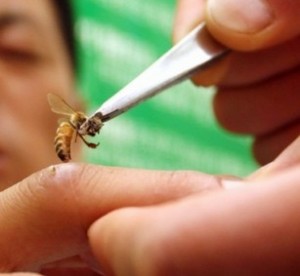
source: altmedicinezone.com
Have you heard of Bee Venom Therapy? While generally people avoid bees because of the fear for their sting, here’s a therapy that forces bees to sting you. Ouch! It may sound awful, but bee venom is known to have many properties that are medically beneficial. This includes anti-inflammatory agents (to reduce inflammation), as well as anti-bacterial properties (to kill bacteria).
Bee Venom Therapy is believed to be good for multiple sclerosis, Lyme disease and chronic fatigue. In the older days, they are used to treat arthritis, back pain and skin diseases. In this therapy the bees are stimulated to sting at affected area or what they call acupuncture points. The success of this therapy is very much debated and there are research proving its ineffectiveness. Well, effective or not, isn’t it weird?
2. Bees and wars.

source: seabeesmuseum.com
Bees seem to be useful in so many ways, not only human take advantage of their hard-working character to produce honey, we force them to sting as a therapy and in ancient time, their whole hive are used as ‘bombs’. Apparently, in history, the Romans catapult in bee hives to their enemies, unleashing angry bees as a distraction. The same strategy were used by the English armies and and Portugese. Some others set bee hives in front of their fortress or as barricades in their cities as a defence strategy against advancing enemies.
3. Dermestid beetles and skulls.
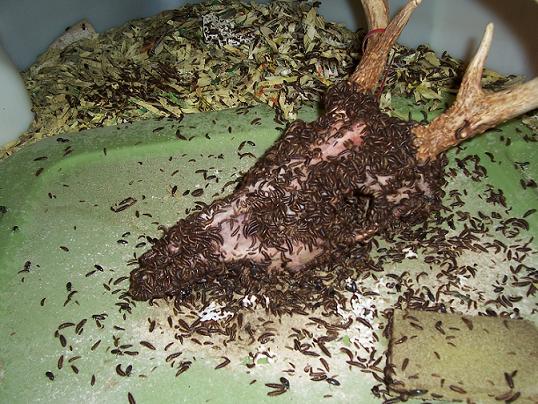
Cleaning up! (source: wattsskulls.com)
So here’s a combination of two creepy things: skulls and flesh-eating beetles. Ever wondered how museums, exhibitions and suppliers clean up their animal skull or skeletons? Yeap, they leave that job for the Dermestids beetles to do. Dermestid beetles are insects of the family Dermestidae. However, not all the members of this family are flesh-eaters.
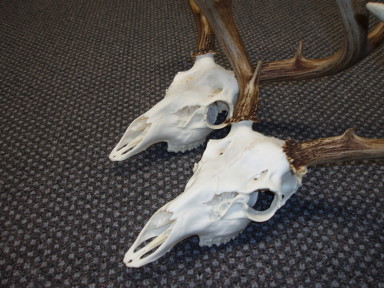
After (source: bonesandbugs.com)
Their ferocious appetite for dead meat are particularly useful for skull cleaning as they would clear every inch of flesh, even in the deepest and difficult angle. All this without causing damage to the bones, the way human tools would. They are even bred by exhibitors and suppliers just for this purpose. But to reduce the creeps, these Coleopterans feed only on dead flesh and do not seem to have the appetite for living things. Phewh!
4. Beetles and accessories.
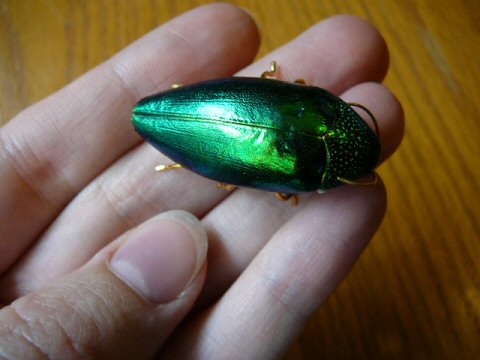
Beetle Brooch (source: weird-websites.info)
There is a family of beetles known as Jewel beetles, which are scientifically known as family Buprestidae. They are named so because of beautiful metallic colouration, which resemble jewels. They have huge varieties in colour including emerald green, metallic blue, red, yellow, purple… you name it. Ironically, because of the jewel-like features of these Jewel beetles, they are also made into jewellery. Literally out of the elytra (the hard forewings) of the bugs themselves. They are made into brooches, earrings, rings and pendants.
5. Insect fights.
Insect fights had been part of the cultures in Asia, including China, Japan, Thailand, Vietnam and Philippines. In these places, insects such as stag beetles, rhinoceros beetle and crickets are kept as pet for this purpose. Cricket fighting dated way back to the Tang Dynasty of China (618-907). Beetle fightings are especially interesting and it involves only male beetles.At the tournament, the beetles are triggered to battle by placing a female before them, or by noise-maker which imitates the female’s call for mating. The winners are determined by one insect pushing its opponent out of the ring, or when its opponent is being flipped over.
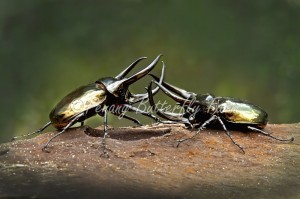
Its like mini sumo, isn’t it?
Posted in Insects, Natural Disaster |
Malaysia Day Special: Rajah Brooke’s Birdwing
Painted Jezebel, August 19, 2011

Trogonoptera brookiana, or more commonly known as the Rajah Brooke’s Birdwing, was first described in 1855 by a British naturalist, Alfred R. Wallace in Borneo.

Alfred Russel Wallace
He named the species in honour of James Brooke, the first Rajah of Sarawak. Up till today, this beautiful butterfly species is commonly known as the Rajah Brooke’s birdwing or The Rajah Brooke’s butterfly.

Sir James Brooke
The Rajah Brooke’s birdwing belongs to the group of butterflies in the family Papilionidae known as the ‘birdwings’ particularly because of their outstandingly big size, pointed wings and their bird-like flight. Apart from that, their resting state posture is unlike other butterflies. Here, this photo would explain it better than me:

The difference between the resting posture of birdwings and other butterflies.
The Rajah Brooke’s birdwing expresses sexual dimorphism, which means the male and female butterfly look different from one another.

The males need to sip in mineral-rich water, as they require sodium and potassium to activate their adult behaviour. Therefore, they are often seen congregating at riverbanks and mud puddles.

In the early years after its discovery, the encounter with the female Rajah Brooke’s birdwing is very rare, that it was thought that the ration between male and female is 1000:1. However, this is untrue. The females tend to fly at higher canopy, therefore minimizing the chance for its encounter.
The Rajah Brooke’s birdwing is one of the most promoted butterflies, particularly here in Malaysia as it is our National Butterfly. Visit Penang Butterfly Farm to see this beautiful ‘King’ live, right before your eyes! And don’t forget your camera!
Posted in Butterflies, Insects, Mother Nature |
Cricket Thermometer
Painted Jezebel, June 13, 2011
When everything else is silenced at night, you’ll hear the crickets’ chirp.
Apart from frequently used as the background sound of a night scene in the movies, or as your gecko pet’s lunch, crickets have another bizarre purpose; a thermometer (surprise!). Weird but, yes, we can actually estimate the surrounding temperature by counting cricket chirps!
(By the way, you don’t need to get Myth Buster to confirm this because Wikipedia has all the proofs you need.)
It was this guy name Amos Dolbear who formulated the Dolbear’s Law that states the relationship between air temperature and the rate of which cricket chirps. He published the law in 1897 in an article called The Cricket as a Thermometer. (Source: Wikipedia)
 Yeap, that’s Dolbear right there.
So how to calculate?
In Fahrenheit (°F)
The number of chirps in 15 seconds is added to 40.
For example: The cricket chirps 44 times in 15 seconds.
Therefore, the temperature would be: 45 + 40 = 80°F
In Celcius (°C)
The number of chirps in 8 seconds is added to 5.
For example: The cricket chirps 20 times in 8 seconds.
Therefore the temperature would be: 20 + 5 = 25°C
However the formula is more accurately applied to a particular species of tree crickets, Oecanthus fultoni, or commonly known as the snowy tree crickets, which are usually found in North America. Here’s a photo of it:
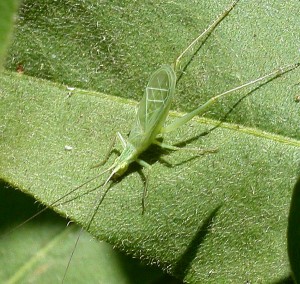
Amazing little thing, isn’t it?
Posted in Insects, Mother Nature |
Newly Hatched Long-Legged Katydids!
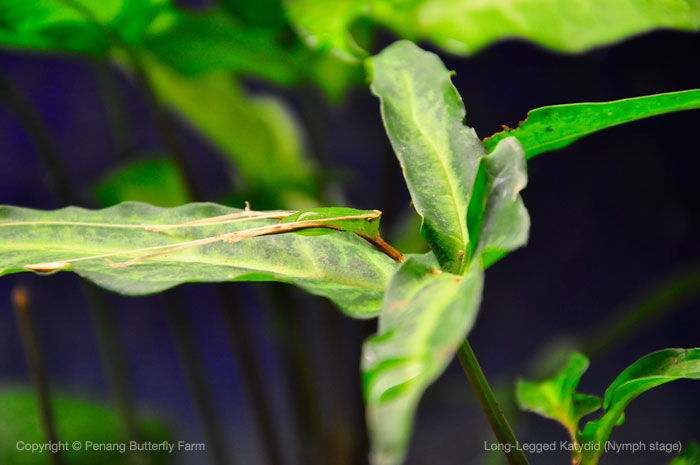
Do you see it??? Can you see its long hind legs?? This little baby katydid together with its brothers and sisters were hatched at our farm just a week ago… While still in nymph stage, its length is already almost 4 inches ~! Don’t miss this little one ~!!
Posted in Insects |