A Lady in Red
Have you ever seen this movie before?

He is a ladybug name Francis in A Bug’s Life movie. By looking at him, do you know that he is a male ladybug? In this movie, He always being teased by the other bugs and mistaken for a female. So, this time, we will discuss about this adorable insect – LADY BIRD
Actually, not all ladybirds are “LADIES”. They are both male and female ladybirds. They are not bugs or birds but they belong to the family of beetles. Ladybugs have a variety of colors like yellow, orange, maroon, and scarlet. So, how ladybirds got their name???
Ladybugs are really ladybird beetles. Their name actually is originated in the middle Ages in Europe. Long time ago, there is a crop disaster happened in a small farming village. Without any effective solutions, the farmers began to beg to the Blessed Virgin Mary to send help in this calamity. Soon, there is a change in the crops, the dying foliage started to revitalize and lastly the greenness of crops once again reappeared on the landscape. Then, the farmers saw many small red bugs with black dots on their concave bodies just like a battle soldier. These small red bugs were eating the destructive pest – aphids. The villagers cheer with saying “Our Lady’s bugs, Our Lady’s beetle”. Consequently, this small bug has become a very familiar pest killer and people give their name as ladybugs.
The ladybug is considered as a symbol of good luck and some cultures even rear them as pets in many countries in the world. Generally they are considered as useful insects, because most of them feed on aphids or scale insects, which are pests in gardens, agricultural fields and orchards. Due to ladybugs huge appetite for crop pests, most of the farmers and gardeners welcome the presence of ladybugs as a blessing and idolize the insect as a lucky symbol.
They can be found worldwide, with over 5000 species described. Both adults and larvae live on plants like roses, oleander, milkweed and broccoli. During the winter, the adults will hibernate in large groups, frequently in mountains at high elevations.
Behavior
Most of the ladybug species are predators. They can be found on the same plants feeding on the same species of prey. They also consume flower nectar, water and honeydew as their supplement. However, only a few ladybug species are plants eaters.
Brightly colored of these ladybugs is to warn their predator that they are distasteful and toxic. Ladybugs can also protect themselves by pretend dead. By pulling their legs up “turtle-style”, and normally release a small amount of blood from their legs. The bad smell and the visible look of death usually prevent their predators. After the threat of danger has passed, the ladybug will return to its normal activities.
In addition, their bodies are not able to handle extreme cold. They will look for shelter when the weather begins to turn cold. During the winter, they rest quietly and this period is called diapause. During diapause, the ladybugs do not grow and they can go without food for 9 months during diapause.

Ladybug and their foods – aphids. www.brisbaneinsects.com/brisbane_ladybirds/
Life cycle

www.willowridge.shs.k12.ny.us/WR_Teacher_Pages/sarnackij/Gr2%20Life%20Ladybug
Check out these fun facts about the ladybugs!!!
- Usually, the female ladybug is larger than the male.
- A female ladybug can lay more than 1000 eggs in her lifetime.
- The females will lay the infertile eggs as well as the fertile eggs.
- In average, the life cycle of a ladybug is between 4 to 6 weeks.
- A hard wing cover protects the ladybug’s fragile wings.
- A ladybug beats its wings 85 times a second when it flies.
- Ladybugs won’t fly if the temperature is below 13 degrees Celsius [55 F].
- The spots on a ladybug fade as they get older.
- Ladybugs use their antenna to smell, taste, and feel its way around.
- They can only see the difference between dark and light but they cannot see colors at all.
- Their larva is like mini alligator and their body adorned with spines.
- The ladybug do not bite, but they will pretend die with hides its legs and antenna under the body.
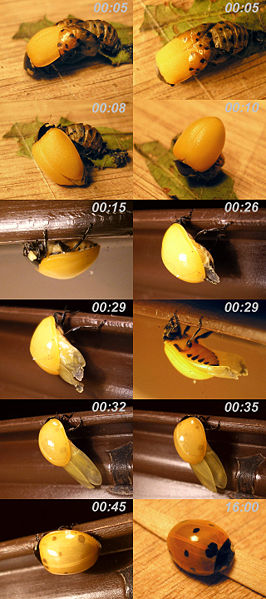
The emergence process of ladybug. www.kidzcraftz.ca/ladybugs.htm
Posted in Insects