Invasive Alien Species: Biodiversity’s Threat.
How many of you have this images in your head when ‘invasive alien species’ is mentioned?

Now an alien from outer space may be fascinating, but in our environment today, invasive alien species are being a problem to our biodiversity. These ‘aliens’ are not exactly short green and big-headed creatures from planet X, but rather, familiar animals and plants being at the wrong place.
What is invasive alien species?
Modernization has allowed human to bring organisms into places where they are not found. For example a Malaysian beetle being brought into South America. When any non-native are introduced to an ecosystem to where they have no (or not enough) predators, they become dominant in the environment. They are called invasive alien species. Many of them disrupt the population of the local species and affect the habitats they invade.
How do they affect the environment?
Because invasive alien species do not have effective predators and survive well in the new environment, their population becomes out of control. This becomes the big problem to the food chain in that habitat. If they feed on plant, plants will be devastated. If they feed on other local animals, they drive these local species to extinction. If they are plants, they compete for nutrient & sunlight with local plants. Many alien species carry and spread germs that harms the local species.
Example of these aliens?
The Story of Feral Goats in Pinta Island
The Pinta Island, a member of the Galapagos Island host many unique species such as giant tortoises, marine iguana and fur seals. The beautiful place became an environmental nightmare when feral goats and other animals were introduced into the island by pirates. Feral goats impacted the vegetation badly by clearing off plants, leaving no food for the Pinta Giant Tortoises. So badly, that there is ONLY LAST KNOWN Pinta Giant Tortoise left in the world, named Lonesome George. He is now kept in Charles Darwin Research Center in Santa Cruz Island. Intensive efforts are being made to hopefully find Lonesome George a partner before it is too late for this subspecies.
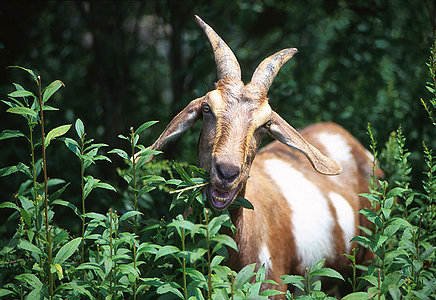
Feral Goat. Source: Tree Of Life Web Project http://tolweb.org/Capra_hircus/51070
The Story of Yellow Crazy Ants in Christmas Island.
The Christmas Island’s ecology is another victim to invasive species. Ever since the yellow crazy ant was accidentally introduced, Christmas Island was never the same again. As the name suggest, these ants become erratic and turns into complete crazies when they are disturbed. These crazy ants feeds on wide variety of food including seeds, grains, decaying matter, vertebrate corpses but worse of all, arthropods. These ants are capable of attacking arthropods like insects and crabs, and dragging them into their colony. The Christmas Island’s red ground crabs are often the victim of these ants. Because the crabs has an annual migration, their movement disturb ant colonies, which resulted in huge red crab massacre. They have killed 30% of the initial crab population, which is about 20 million crabs! Studies has also shown that many other wildlife in Christmas Island had reduced in population numbers ever since the yellow crazy ants invaded.
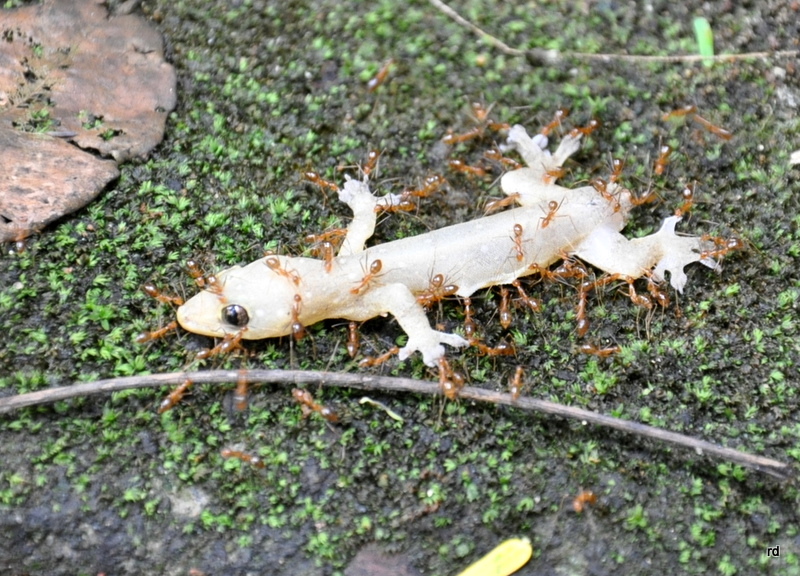
Yellow crazy ants dragging away a lizard. Source: Wikepedia.
That’s not just it
These are just 2 of the many stories of invasive alien species. There are many more known trouble makers, around the world such as the Asian Carp in America, Burmese pythons, Zebra mussels, Lion fish, Africanized bees and Cane toads. Not forgetting rats that has invaded many-many parts of the world, and carry deadly diseases. One of it was the Black Death, where the plague killed 30-60% of Europe’s people between 1348-1350. European rabbits are known to be a great devastator to Australian, where 24 rabbits released in 1859 had multiplied to 600 million in 1937. They ate up vegetations, removed topsoil and threatened local species.
Invasive alien species has indeed been a serious problem to our biodiversity. Based on the IUCN Red List of Threatened Species, 20,435 species of plants and animals are affected by invasive species, including 801 that was declared extinct. These stories should be a lesson to mankind on the importance of preserve how nature has been placed. These are also lessons to us to realize how small things lead to big problem. There’s always a reason and purpose for different things to be at their designated habitat and environment. Nature has always been the smart one 🙂
To know more about what’s going on with Biodiversity, including other threats to the environment and endangered animals, head over to Penang Butterfly Farm’s Biodiver-City hall in the indoor exhibition area 🙂Posted in Mother Nature